REVIEW · NAPLES
Private Walking Tour through the Historical City of Herculaneum
Book on Viator →Operated by Guide Centre Sorrento · Bookable on Viator
Herculaneum feels personal in a way few ruins do. This private walking tour is built around the park’s most compelling highlights, from the preserved thermal complex to houses famous for charred wood and dazzling mosaics, all paced so you don’t feel rushed.
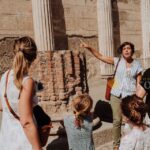
What I love is how the tour turns scattered ruins into a clear story of everyday Roman life, with stop-by-stop explanations that help you know what you’re looking at. I also like the small-group feel—one guide, your group, and time to ask questions—plus the flexibility for slower walkers.
The main consideration is that you’ll still need to plan for the Archaeological Park ticket (listed as €16 per person, free under 18 with a document). On a hot day, add water and good shoes, because you’ll be moving outdoors for the whole experience.
In This Review
- Quick hits before you go
- Why Herculaneum hits harder than you expect
- The value of a private 2-hour format
- Meeting point and what to expect on the ground
- Stop-by-stop: the Roman world in 10–15 minute blocks
- 1) Terme del Foro: Roman baths that still make sense
- 2) Partem Domus lignea (Casa del Tramezzo di Legno): charred wood furniture
- 3) Casa di Nettuno e Anfitrite: mosaics with myth
- 4) Casa dei Cervi: marble color and a panoramic location
- 5) Casa Sannitica: early Pompeian-style painting
- 6) Salone della Barca di Ercolano: the charred boat museum
- 7) College of the Augustales: a public temple with frescoes
- 8) Casa del Salone Nero: the Black Hall and fresco conservation
- 9) Antiquarium di Ercolano: exhibitions when you want more
- Price and tickets: what’s included, what to budget
- Which guides you might get, and how that affects the day
- Who this tour is best for
- Should you book this private Herculaneum tour?
- FAQ
- Do I need to pay an entrance fee for Herculaneum?
- How long is the private walking tour?
- Is the tour private?
- What language is the tour offered in?
- Where does the tour start and end?
- What should I bring for the walk?
- Can I get a refund if plans change?
Quick hits before you go
- Private guide, private time: only your group participates, so the pace can match your needs.
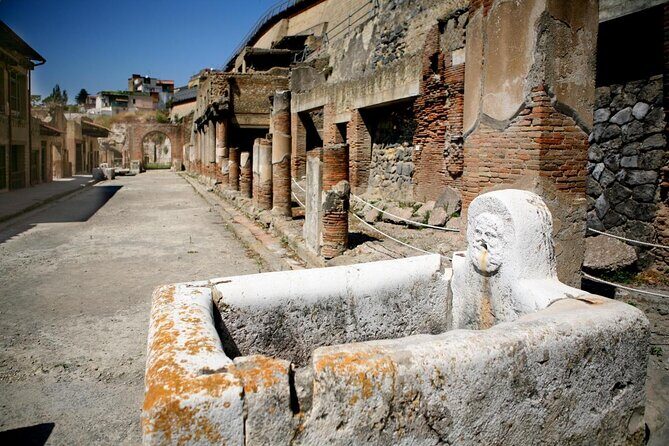
- Herculaneum’s “intact” advantage: the site is often easier to wrap your head around than Pompeii, because more structures survive.
- A smart mix of houses and public life: baths, temples, and homes—so you get more than pretty mosaics.
- Charred wood and the boat museum: you’ll see how preservation works in Herculaneum, including a famous ancient boat display.
- Tickets and timing are bite-sized: most stops run about 10–15 minutes, which keeps momentum without rushing.
- Discretion built in: there’s an option to spend extra time at the museum exhibitions if you want it.
Why Herculaneum hits harder than you expect
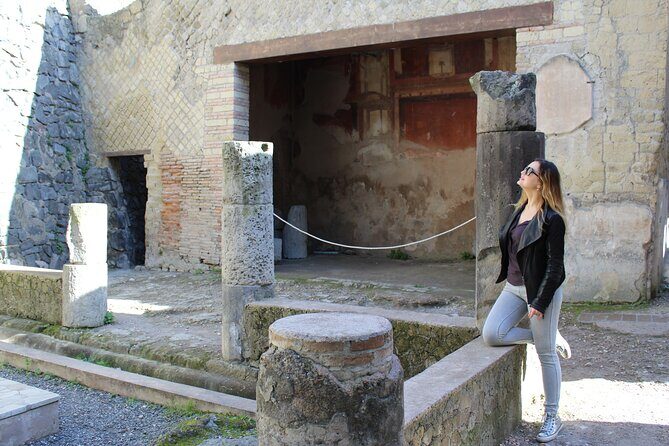
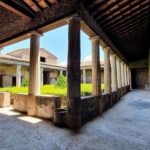
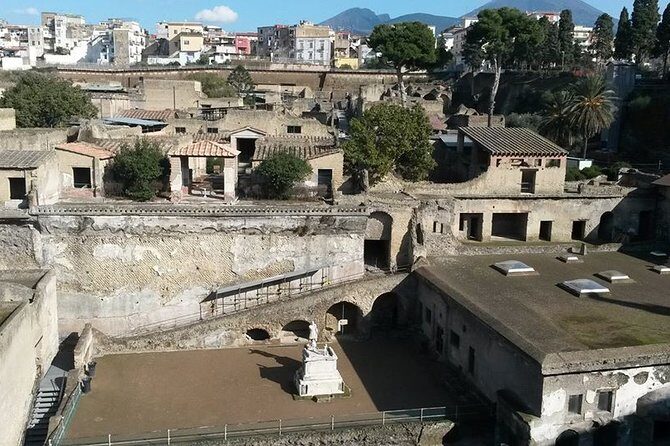
Herculaneum is the rare “ruins” experience where your brain starts filling in the missing pieces fast. The big idea here is that only part of the ancient city is excavated, and a lot still sits underground. That changes the vibe immediately: you’re not walking through a complete city grid, you’re touring the portions that were uncovered and preserved.
I also like that the focus stays practical. You’re not just chasing big photo spots. You’re learning how Roman spaces worked—how people washed, how homes were decorated, and what public buildings were for—so the site feels like a lived-in place, not an open-air textbook.
Other Herculaneum guided tours and tickets we've reviewed at Vesuvius & the Bay of Naples

The value of a private 2-hour format
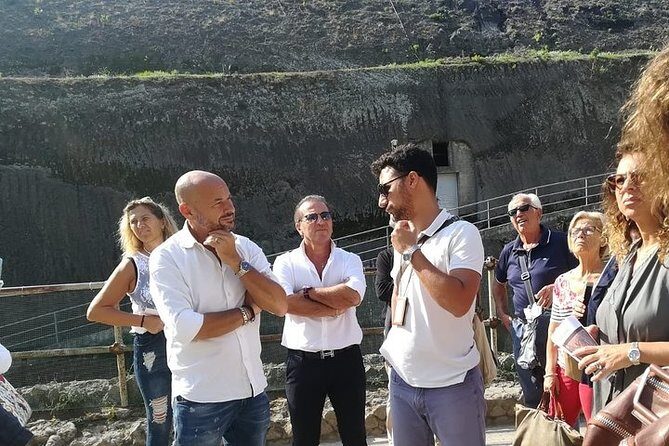
This is a 2-hour tour that’s set up like a guided highlights route. For me, that’s a sweet spot. Long enough to see real variety—baths, multiple houses, and a public temple—but short enough that you don’t feel defeated by heat or fatigue.
At $102.12 per person, you’re paying mainly for the guide and the private structure: licensed archaeologist-style interpretation, a plan that gets you from stop to stop efficiently, and time to ask questions without worrying about holding up strangers. You’re also getting a Mobile ticket, which usually means less stress than printing and hunting for paperwork.
One more point: the tour is designed so you’re not stuck in “run here, look fast, run again” mode. Several guides are described as patient with extra time, including situations with elderly visitors and strollers, which is exactly what you want if your group moves at different speeds.
Meeting point and what to expect on the ground
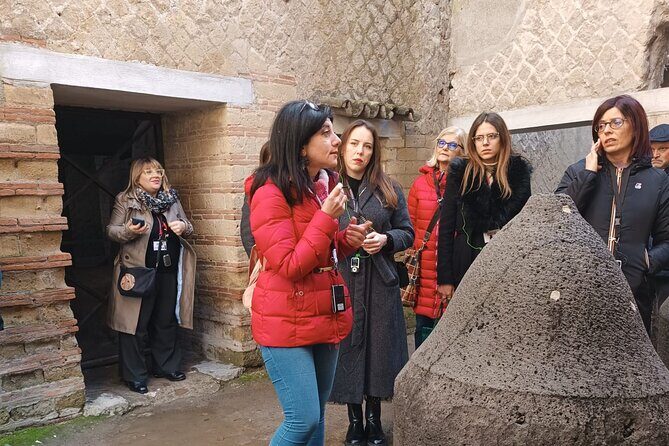
You start at the Archaeological Park of Herculaneum, Corso Resina, 187, in Ercolano. The tour ends back at the same place, so you won’t have to figure out a complicated meetup around transit.
This kind of walk is best treated like an outdoor museum circuit. Wear comfortable shoes and expect some walking on uneven surfaces. The tour recommends sunglasses and a hat, which is smart—Herculaneum can be bright and warm, and you’ll be outside between stops.
If you’re traveling with a service animal, the tour allows them, and it’s also close to public transportation. That’s helpful if you’re not hiring a driver or you’re connecting from Naples.
Stop-by-stop: the Roman world in 10–15 minute blocks
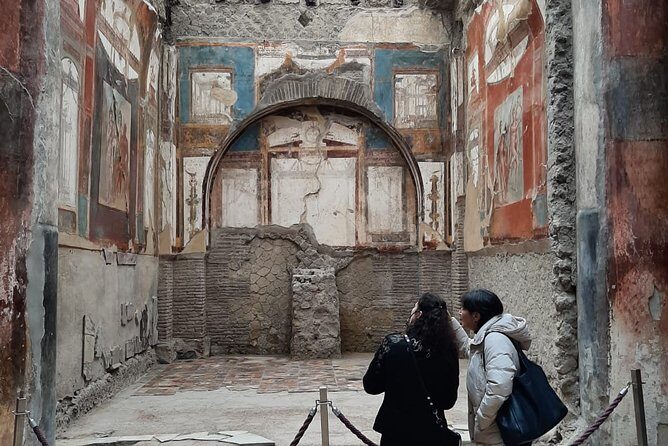
1) Terme del Foro: Roman baths that still make sense
Your first stop is Terme del Foro, a thermal system that’s especially well preserved. Even if you don’t know Roman sanitation terms, this is one of those places where the layout does the teaching. You’ll see spaces tied to changing and the sequence of warm and warm-bath areas (the kinds of steps visitors followed in Roman bathing culture).
Why this stop matters: it gives you a baseline for how public life worked in Herculaneum. Baths weren’t just hygiene. They were social time, routine time, and a big part of how people structured their day.
Timing is short—about 15 minutes—but because the guide points out what’s what, you’re not spending that time wondering where to look.
Other private and VIP tours we've reviewed at Vesuvius & the Bay of Naples

2) Partem Domus lignea (Casa del Tramezzo di Legno): charred wood furniture
Next is Partem Domus lignea, often linked to the Casa del Tramezzo di Legno. The headline here is charred wood furniture—preserved in a way that’s hard to imagine until you see it.
This is one of the most emotionally striking stops, because it turns “the eruption catastrophe” into an immediate material reality. You start thinking about objects and routines, not just walls and floors.
You’ll spend around 15 minutes here with admission included, which feels right. Too long and it becomes “wow” fatigue. Done at a good pace, it stays sharp.
3) Casa di Nettuno e Anfitrite: mosaics with myth
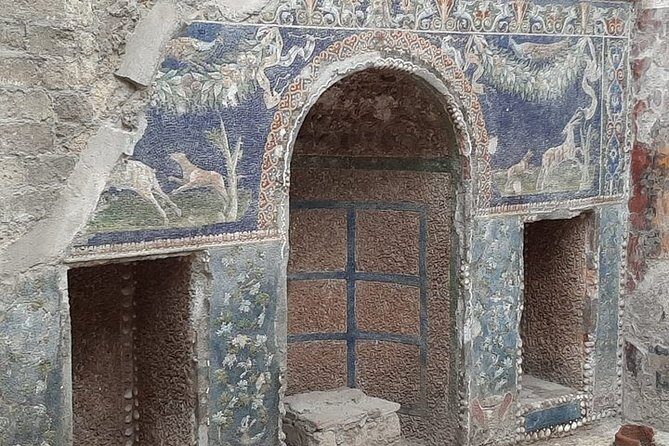
Then you’ll move to Casa di Nettuno e Anfitrite, a symbolic house known for a standout mosaic. This is a great contrast to the wood stop: instead of textured survival, you get decoration and storytelling.
Mosaics matter because they weren’t just floor art. They were identity, taste, and myth in a domestic setting. When you know what you’re looking at—who Neptune and Amphitrite are representing, and why that imagery appears—you stop treating mosaics as decoration and start treating them like “Roman branding.”
Plan about 15 minutes at this stop.
4) Casa dei Cervi: marble color and a panoramic location
At Casa dei Cervi, you’ll get the “deer house” in a spectacular position between the Gulf of Naples and Capri. It’s described as full of polychrome marble, and that color is the whole point. You’re seeing how wealthy Romans used material and color to make a home feel alive.
The panoramic setting adds something you shouldn’t skip: your surroundings help you understand why this location mattered so much. Yes, you’re touring the past. But you’re also learning how people chose where to live.
This stop is shorter—around 10 minutes—which is enough time to appreciate the details without rushing the rest of the route.
5) Casa Sannitica: early Pompeian-style painting
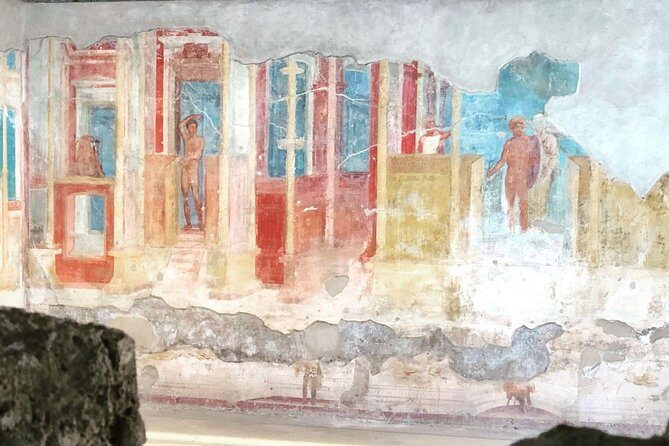
Next is Casa Sannitica, known for pictorial decoration in an early Pompeian style. If you’ve seen Pompeii wall painting before, you’ll recognize the style evolution—but this stop is especially useful because it shows how earlier decoration worked.
Why I think you’ll like it: you start to see Herculaneum as more than “the small intact alternative to Pompeii.” The houses have different design ideas, different time periods, and different artistic choices.
This also runs about 10 minutes, so it’s a quick but meaningful visual stop.
6) Salone della Barca di Ercolano: the charred boat museum
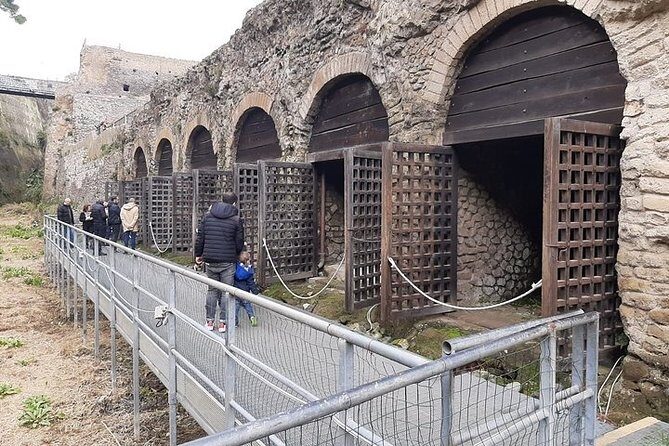
After the main archaeological area stops, you’ll head to the Salone della Barca di Ercolano, a small museum where you can admire the ancient charred Roman boat and other finds. This is one of those stops that changes your brain from “walking through ruins” to “seeing surviving artifacts.”
It’s outside the core park walkthrough, but that’s part of the value. A walking tour only gives you part of the story. This small museum portion helps you connect what’s been excavated with what’s still preserved as objects.
You’ll have around 15 minutes here.
7) College of the Augustales: a public temple with frescoes
Now the tour shifts from domestic life to a public religious space: the College of the Augustales. This is one of the few public temples excavated that you can visit, and it’s known for mythological frescoes.
If you’ve ever wondered why Roman myths show up in everyday settings, this stop is your clue. Mythological frescoes weren’t random. They supported identity, belief, and power.
You’ll spend about 15 minutes at this stop.
8) Casa del Salone Nero: the Black Hall and fresco conservation
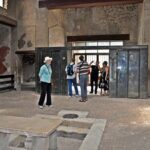
Next is Casa del Salone Nero, the house of the black hall overlooking Herculaneum’s main street. It’s interesting for the state of conservation of its frescoes, and it reflects a “Vitruvian model,” meaning there’s a design logic tied to Roman architectural thinking.
The key thing here is conservation. When frescoes survive, you can actually study how color, contrast, and composition were meant to look. Your guide helps you focus on that rather than letting you get lost in general admiration.
This is a 10-minute stop.
9) Antiquarium di Ercolano: exhibitions when you want more
Finally, you have the option to visit the Antiquarium di Ercolano. This is where you can see permanent and temporary exhibitions at your discretion, with finds like jewelry, everyday objects, and charred wood furnishings.
The “discretion” part is valuable if your group is museum-curious. If you’re not into extras, you don’t have to overstay. If you are, this last stop can extend the emotional impact of the tour by moving from rooms and layouts into real objects.
You’ll have about 15 minutes for this.
Price and tickets: what’s included, what to budget
The tour is listed at $102.12 per person and includes the licensed guide, taxes, and the private format. Most stops are marked with admissions included, but the Archaeological Park of Herculaneum entrance fee is listed separately as €16 per person (free under 18 with a document).
So here’s how I’d budget it: plan on paying the park ticket on top of the tour price, then enjoy knowing your guide part is already covered. If you’re traveling with teens, double-check the document for under-18 eligibility before you go.
Also, it’s a good idea to bring your sunglasses and hat, and to wear shoes you can trust on uneven ground. Herculaneum isn’t a “flip-flops and photos” site.
Which guides you might get, and how that affects the day
One of the best signals in the provided feedback is that guides keep it human and adjustable. Names mentioned include Martina, Carmine, Francesca, Annalisa, Alessandro, Ernesto, Luciano, and Eugenio.
What I take from that for your planning: the tour’s success depends heavily on the guide’s ability to explain what matters—especially with so many different house types and art styles packed into two hours. If your guide is strong, you’ll leave with a real understanding of Roman life patterns, not just a list of rooms.
One extra detail I’m glad to hear exists: some guides bring practical touches like a water spray on hot days. Not every guide will do that, but it’s a nice reminder that you’ll be walking in real weather, not indoors.
Who this tour is best for
This private format is ideal if you want:
- A smaller group experience where you can ask questions freely
- A short, structured walk that still covers meaningful variety
- A guided approach if Herculaneum is new to you and you want context fast
It also fits well if you have mixed mobility needs, based on examples of guides being patient with extra time and strollers. If your group includes older adults or kids who need more breaks, a private guide is often worth it because the pace can flex.
If you’re the type who enjoys archaeology as a story—how people lived, what they valued, and how spaces worked—this tour style is a strong match.
Should you book this private Herculaneum tour?
If you have limited time in Naples, want a calmer alternative to the bigger Pompeii comparison, and you’d rather understand the site than just see it, then yes. A private 2-hour walking tour gives you structure, expert interpretation, and a finish time that won’t eat your whole day.
I’d especially book it if you’re going with family, mixed ages, or anyone who benefits from slower pacing and good explanations. The stop list is built for variety—baths, houses with charred wood and famous mosaics, a temple with frescoes, and a small museum with the charred boat—so you get a full picture without it turning into a marathon.
Just don’t forget the park ticket in your budget, and dress for outdoor walking. Do that, and you’ll have one of the most memorable “the past is real” ruins visits in the area.
FAQ
Do I need to pay an entrance fee for Herculaneum?
Yes. The Archaeological Park of Herculaneum entrance fee is listed as €16 per person. It’s free under 18 with the right document.
How long is the private walking tour?
It’s listed as about 2 hours.
Is the tour private?
Yes. It’s a private activity, meaning only your group will participate.
What language is the tour offered in?
The tour is offered in English.
Where does the tour start and end?
It starts at the Archaeological Park of Herculaneum (Corso Resina, 187, 80056 Ercolano NA, Italy) and ends back at the same meeting point.
What should I bring for the walk?
The tour recommends sunglasses, a hat, and comfortable shoes/clothing.
Can I get a refund if plans change?
The experience offers free cancellation up to 24 hours in advance for a full refund.