REVIEW · NAPLES
Herculaneum Private Tour with an Archaeologist
Book on Viator →Operated by ELIANA SANDRETTI · Bookable on Viator
Herculaneum feels quieter than you expect. This private, archaeologist-led walk through the Parco Acheologico di Ercolano brings the town’s daily life and the 79 AD eruption into focus, stop by stop, for a small group. I love the expert explanations in English and the way you get to see the buildings and objects that make the story feel real.
My other favorite part is the pacing: you hit the big emotional moments, like the Terrace area tied to the eruption’s victims, then move into the luxury houses and their preserved details. The tour is also structured so you’re not wandering around guessing. One possible drawback: the entrance ticket is not included, so you’ll want to budget that extra cost upfront.
In This Review
- Key Highlights I’d Plan Around
- Why Herculaneum Makes a Strong Case on Your Naples Trip
- Meet at the Herculaneum Ticket Office and Get Oriented Fast
- Parco Acheologico di Ercolano: Where the Town’s Story Starts
- Admission to budget first
- La Terrazza di M. Nonio Balbo: The Eruption Hit, Up Close
- Casa dei Cervi: Sea Views and Luxury After the Disaster
- Casa dei Cervi’s Myth Detail: Telephus and the Carved Clues
- Wooden Partitions, Charred Evidence: Partem Domus lignea
- Casa del Tramezzo di Legno and the Feeling of Real Space
- Casa del Salone Nero: The Black Room That Still Grabs Attention
- Salone della Barca di Ercolano: A Recently Discovered Boat
- College of the Augustales: Frescoes and a Skeletoned Story
- House of the Skeleton: The Name That Stops You
- Casa Sannitica: One of the Oldest Houses
- Casa di Nettuno e Anfitrite: Finish Strong With Scene-Rich Rooms
- Price and Value: Is $349.98 a Good Deal?
- Practical Tips That Make This Tour Easier
- Should You Book This Private Herculaneum Archaeologist Tour?
- FAQ
- How long is the Herculaneum private tour with an archaeologist?
- What is the price and group size?
- What language is the tour offered in?
- Where do we meet for the tour?
- Is the entrance ticket to Herculaneum included?
- Are there any stops on the itinerary that have free admission?
- What’s included in the tour price?
- Is this tour offered as a private experience?
- Does the tour depend on weather?
- Are service animals allowed?
Key Highlights I’d Plan Around
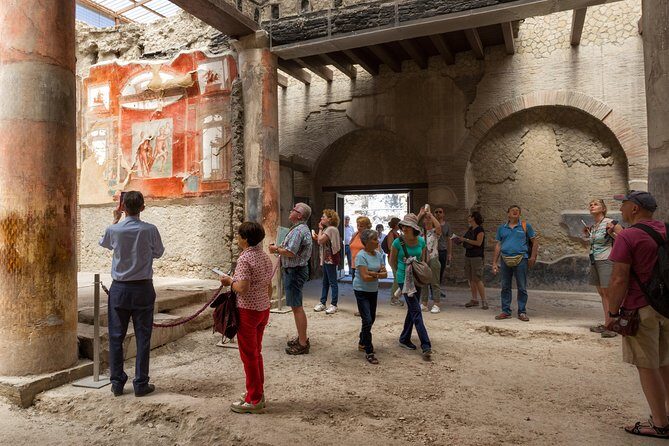
- An archaeologist-led private visit (up to 10 people), so you can ask questions without yelling over crowds.
- Two hours that stay focused, covering major domus, fresco rooms, and eruption evidence.
- Stops built around what survived: charred wood partitions, a black-painted salon, and even a boat.
- The eruption context comes early, starting with the terrace viewpoints and moving into house-level details.
- Marked short visits at each stop (about 10–15 minutes), which helps you cover more without feeling rushed.
Why Herculaneum Makes a Strong Case on Your Naples Trip
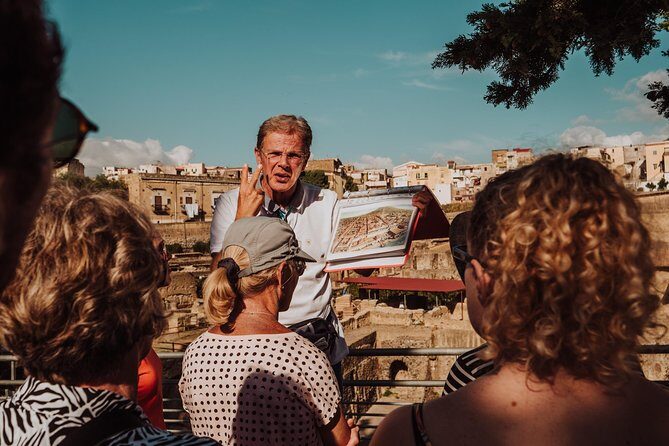
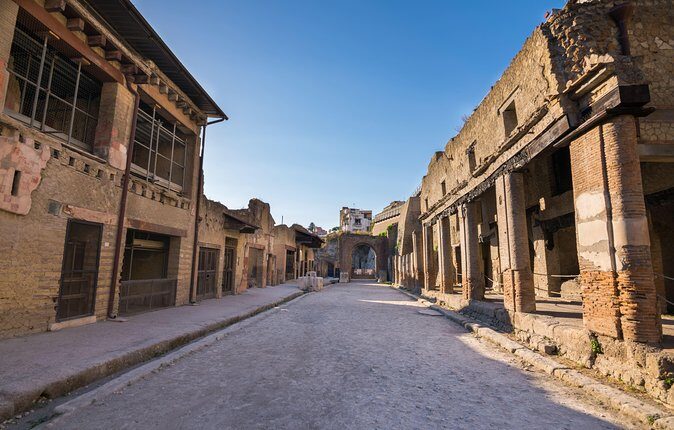
If you’ve already done Pompeii, Herculaneum can feel like a different planet. Pompeii is huge, loud, and spread out. Herculaneum is smaller, denser, and often more intimate because you’re looking at houses and rooms where everyday life happened right up to the moment it stopped.
This tour leans hard into that advantage. You’re not just seeing walls. You’re moving through spaces that help you picture what people ate, how they decorated their homes, and how the eruption changed everything in seconds. Even though the visit is around 2 hours, it’s long enough to build a clear timeline: before the eruption, during the disaster, and what survived afterward in the carbonized and protected layers.
You also get real guidance at the hardest part: knowing what you’re looking at. Roman homes can look similar until someone points out the details—like where you’d expect guests, how space was organized, and what the preserved materials mean for how the eruption affected the town.
Other Herculaneum guided tours and tickets we've reviewed at Vesuvius & the Bay of Naples

Meet at the Herculaneum Ticket Office and Get Oriented Fast
Your tour starts at the Archaeological Park of Herculaneum, at the ticket office on Corso Resina, 187, in Ercolano. You’ll be able to buy entrance tickets there if you didn’t already purchase online, which is handy if your Naples day runs late.
At the meeting point, the guide will be easy to find, holding a sign for Eliana Sandretti. That sounds like a small detail, but it matters in archaeological sites. When you’re walking with a group, the first 5–10 minutes can decide whether the day feels smooth or stressful.
Also, the tour is listed as private, meaning only your group participates. That’s a big deal here because the site is built for a self-guided crowd flow. With a private guide, you get a more direct route through the key areas, without playing leapfrog around other groups.
Language-wise, it’s offered in English, and the overall structure is very Q-and-A friendly, which is exactly what you want when you’re staring at rooms that have been silent for nearly 2,000 years.
Parco Acheologico di Ercolano: Where the Town’s Story Starts
Stop 1 is the Parco Acheologico di Ercolano itself, where you’re basically setting your “mental museum map.” The park entrance ticket gives you access to the attractions and houses included in the tour route, and this is the piece to plan for since the ticket is not included in the tour price.
Once you’re in, the guide’s job becomes translation. The eruption didn’t just destroy a city. It also preserved parts of it in unusual ways. Those preserved elements are the reason Herculaneum feels so personal. You’re not reading about Romans; you’re seeing the rooms where Romans moved.
Here’s the practical angle: if you arrive tired or unsure what matters, this is where you get the orientation you’ll use for every stop after. With an archaeologist handling the “what am I looking at?” layer, you’ll spend your attention where it counts.
Admission to budget first
The entrance ticket for the archaeological park is €15 for adults. Under 18 tickets are free. Plan on buying that ticket either online or right at the start when you meet your guide.
La Terrazza di M. Nonio Balbo: The Eruption Hit, Up Close
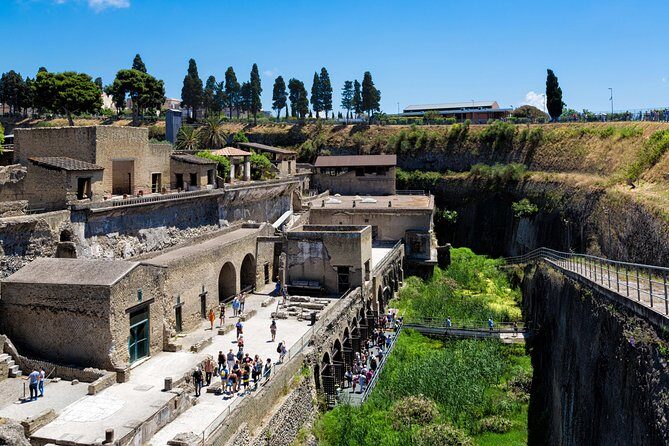
Stop 2 brings you to La Terrazza di M. Nonio Balbo, with a short visit (about 5 minutes) but a huge emotional weight.
This is where you can see the skeletons of people who died during the eruption. You’ll also look out from the terrace to imagine the panorama before the big explosion of Vesuvius. That pairing—human remains plus the view—turns the eruption from an abstract event into something you can picture.
Practical tip: don’t rush this stop. The point isn’t just to say you saw it. It’s to understand that the terrace is part of the story’s physical logic. People were on the move, hoping for safety, and the landscape around them mattered.
It’s sobering, yes. But it’s also the reason this tour works. Once you’ve faced that context, the later stops in the houses land with more meaning.
Other private and VIP tours we've reviewed at Vesuvius & the Bay of Naples

Casa dei Cervi: Sea Views and Luxury After the Disaster
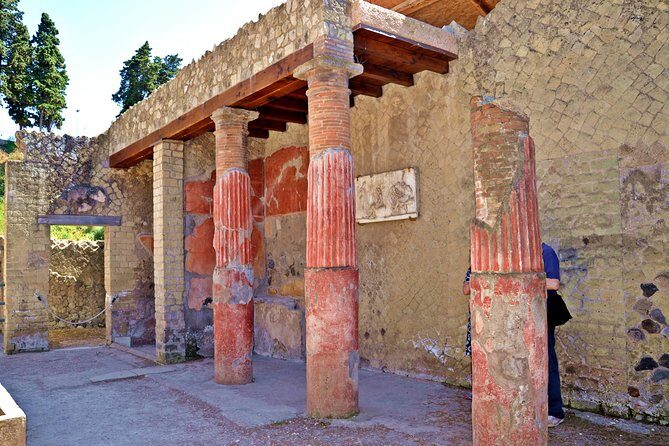
Stop 3 is Casa dei Cervi, a luxurious house with a terrace overlooking the sea. You’ll spend about 15 minutes here.
This stop shifts the tone. Instead of the eruption’s immediate tragedy, you’re back in the rhythm of a Roman elite home: the way you’d host, how you’d enjoy outdoor space, and why a sea view was worth preserving as a daily pleasure.
The key value here is contrast. When you move from the terrace area linked with victims to a wealthy domus with a view, you feel the scale of what was at stake. It wasn’t only a disaster for the poor. It disrupted everyone’s plans, home routines, and sense of safety.
And if you’re wondering why a guided tour matters: a house like this can look like “just another ruin” unless someone explains how luxury and daily life were staged through space.
Casa dei Cervi’s Myth Detail: Telephus and the Carved Clues
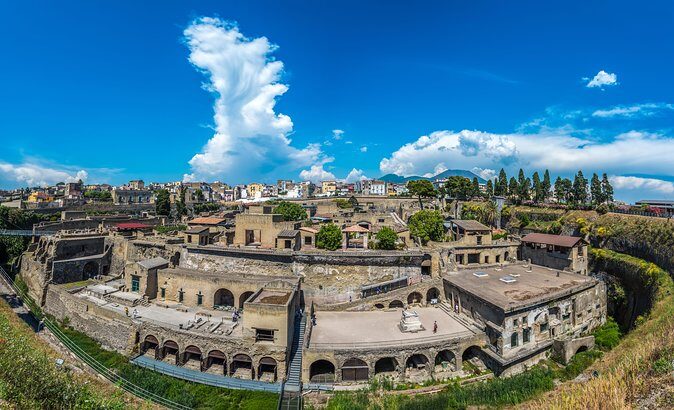
You’ll also encounter a naming detail tied to a high relief illustrating the myth of Telephus. This is the kind of small art-historical note that becomes a big deal once you understand what it means for Roman identity.
Roman homes weren’t decorated at random. Myth scenes and symbolic themes helped residents signal education, values, and taste. Having a guide call out the specific story behind the artwork helps you avoid the trap of just snapping photos of surfaces.
This is also why the tour feels more like a guided interpretation than a checklist. You leave stops with a better “why,” not just a better “what.”
Wooden Partitions, Charred Evidence: Partem Domus lignea
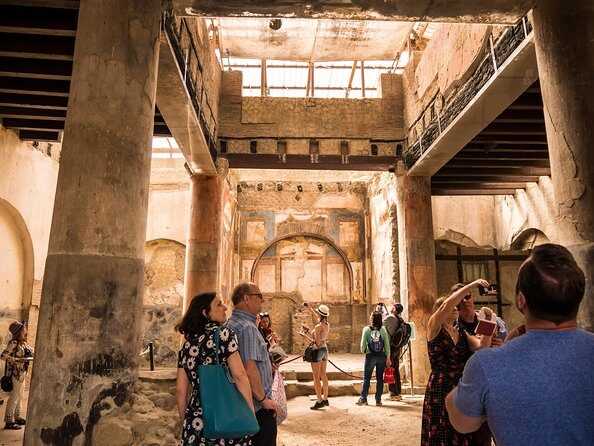
Stop 4 is Partem Domus lignea – Casa del Tramezzo di Legno, with about 15 minutes.
The big feature here is the wooden partition that was discovered charred due to the eruption of Vesuvius. That detail hits hard because wood doesn’t normally survive in ruins. In this case, preservation conditions helped keep evidence that lets you see how structures were arranged.
This stop is also a reminder of how archaeology works. It’s not just about pretty frescoes. It’s also about physical proof—materials, burn patterns, and construction methods—that help reconstruct how the house functioned.
If you like science-y evidence—what survived, what didn’t—this is one of the stops that justifies the price beyond simple site access.
Casa del Tramezzo di Legno and the Feeling of Real Space
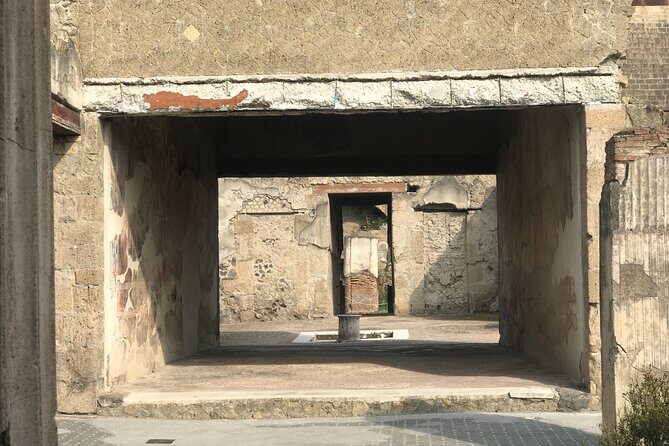
Even in a short visit, this is the stop where you start thinking in “rooms.” Guides help you imagine circulation and separation in the home: where boundaries existed, how privacy might work, and how people moved through shared and private zones.
You’ll be tempted to treat everything as equal, but this stop tends to make people slow down for a reason. The charred wood is a tangible bridge to a moment of sudden destruction.
Casa del Salone Nero: The Black Room That Still Grabs Attention
Stop 5 is Casa del Salone Nero, about 15 minutes. It’s named for the salon painted in black and described as one of the most luxurious domus in Herculaneum.
Painted rooms are fun because your brain wants to fill in what you’re seeing. The black color isn’t just decoration—it’s a signal. It suggests wealth and taste, and it makes the room feel different from the typical “neutral ruin” impression people have when they first arrive.
If you’re into art, this is the kind of stop where you’ll want to stand quietly for a moment and let your eyes adjust. A guided explanation helps you see how wall painting and room design worked as a package.
Salone della Barca di Ercolano: A Recently Discovered Boat
Stop 6 is Salone della Barca di Ercolano, again about 15 minutes. You’ll see the boat charred by the eruption of Vesuvius, and the tour notes that it’s recently discovered.
A boat in a house context can surprise people. That reaction is useful. It forces you to rethink what kind of everyday life this town supported—how close it likely felt to the water and how daily goods and activities might connect to maritime routines.
This stop is one of those “how is this real?” moments. It’s also a strong reminder: Herculaneum isn’t only buildings. It’s objects that tell you what life looked like.
College of the Augustales: Frescoes and a Skeletoned Story
Stop 7 is the College of the Augustales, about 15 minutes.
This room preserves frescoes representing Hercules entering Olympus. You’ll also see the skeleton of a keeper who died during the eruption.
Two things make this stop powerful. First, the art gives you a heroic myth scene—Roman religion and symbolism painted on walls. Second, the human evidence ties that myth-world back to a real person, caught in the disaster.
If you’re looking for why private guidance matters: a fresco can look like “a painting” until you understand where it sits in meaning—what the subject likely signaled, and why a room like this mattered to community identity.
House of the Skeleton: The Name That Stops You
Stop 8 is the House of the Skeleton, about 10 minutes. It’s named for the discovery of a skeleton of an inhabitant who was unable to save himself.
This stop is short, but it’s a “don’t speed walk it” moment. A guided approach helps you keep the focus where it belongs—on how the disaster unfolded for real people, not just on the shock value of the discovery.
Casa Sannitica: One of the Oldest Houses
Stop 9 is Casa Sannitica, about 15 minutes. It’s described as one of the oldest houses in Herculaneum.
This is where the tour subtly shifts from “big tragedy” and “luxury details” into “history of the town’s development.” When you see older construction patterns, you start thinking about how a community changes over time, even when the end date is a catastrophe.
If you’re the type who likes architecture and time layers, this stop gives you something to chew on without adding extra walking.
Casa di Nettuno e Anfitrite: Finish Strong With Scene-Rich Rooms
Stop 10 is Casa di Nettuno e Anfitrite, about 15 minutes. The tour notes that the room compositions are rich and scenic, and that the setting can leave you speechless.
This is a strong closing move. After seeing evidence of the eruption and a range of household interiors, you end with imagery-driven rooms that reflect how Romans used art to shape atmosphere and identity.
Practically, ending with a visually intense house means it’s harder to lose focus. By this point you’ll have context for what you’re seeing—how rooms reflect status, how decoration carries meaning, and why preservation here is so rare.
Price and Value: Is $349.98 a Good Deal?
The tour is priced at $349.98 per group for up to 10 people, lasting about 2 hours.
Here’s how I’d judge value. If you’re traveling solo or as a couple, the price can feel steep until you remember it’s private and led by an archaeologist, not a basic group guide. If you’re traveling with a small group—family or friends—this can look much more reasonable fast because the cost is shared.
Then there’s the real “value math” beyond dollars: you’re getting a tight route through major points you can’t easily prioritize alone. You’re also paying for interpretation—the part of the experience that turns carbonized wood, black-painted rooms, and myth frescoes into something you actually understand during the visit, not after you get home.
Do keep one cost in mind: the park entrance fee is extra (adult €15; under 18 free). If you’re budgeting, treat the tour as the guided service and treat the entrance ticket as the park’s separate fee.
Practical Tips That Make This Tour Easier
A few things I’d plan around based on how this experience is set up:
- Bring your entrance ticket plan. You can buy at the ticket office if you didn’t pre-book. Still, having it straight helps.
- Expect short stops. Many points are about 10–15 minutes. That’s not a problem; it’s how the tour covers key areas without dragging.
- Wear shoes for uneven ground. Archaeological sites are not museum floors. Even when a visit is “most can participate,” you’ll still want comfortable footing.
- Ask questions at the start. Early context makes every later room easier to read.
- Good weather matters. The tour notes that it requires good weather. If conditions are rough, you may be offered another date or a full refund.
Should You Book This Private Herculaneum Archaeologist Tour?
If your goal is to understand Herculaneum instead of just touring it, this is a smart booking. The highlights here aren’t random. They’re carefully built around the pieces that make the eruption and everyday Roman life connect: victims’ evidence at the terrace, luxury domus like Casa dei Cervi, preserved woodworking evidence, and art-rich rooms such as Casa del Salone Nero and Casa di Nettuno e Anfitrite.
I’d book it especially if you:
- want a smaller-group experience while staying inside a tight Naples schedule,
- care about why certain rooms and objects matter,
- like asking questions and getting straight answers in English.
You might skip—or at least consider adding extra self-guided time—if your only goal is a quick “ruins photos” stop. A guided, two-hour interpretation shines when you want context. Without that, parts of the site can feel like you’re looking at walls without the story.
If Herculaneum is on your list, do yourself a favor: pick the tour route with real archaeological interpretation. It turns the visit from seeing into understanding.
FAQ
How long is the Herculaneum private tour with an archaeologist?
The tour lasts about 2 hours.
What is the price and group size?
It costs $349.98 per group and is for up to 10 people.
What language is the tour offered in?
The tour is offered in English.
Where do we meet for the tour?
You meet at the Archaeological Park of Herculaneum ticket office, Corso Resina, 187, 80056 Ercolano NA, Italy.
Is the entrance ticket to Herculaneum included?
No. The private tour entrance fee is €15 per person (adult rate for the park entrance, with free tickets for under 18).
Are there any stops on the itinerary that have free admission?
Stops listed as Admission Ticket Free include the terrace viewpoint and multiple domus/rooms after the main park entry.
What’s included in the tour price?
The tour includes an archaeological guide and assistance, a specialized archaeological guide, the private tour, and taxes.
Is this tour offered as a private experience?
Yes. It is private, and only your group participates.
Does the tour depend on weather?
Yes. The experience requires good weather; if it’s canceled due to poor weather, you’ll be offered a different date or a full refund.
Are service animals allowed?
Yes. Service animals are allowed.