REVIEW · POMPEII
Pompeii and Herculaneum small group Excursion from Naples
Book on Viator →Operated by Askos Tours · Bookable on Viator
Pompeii and Herculaneum in one tight day. I like how this shore excursion handles port-area pickup and round-trip minibus transport, so you’re not wrestling buses and taxis before you even reach the ruins. I also like the archaeologist-led small-group feel, with guides such as Rafael earning praise for making the sites easier to follow and more fun to visit.
The main trade-off is pacing. With about 7 hours total and many short stops in Pompeii, you’ll see a lot, but you won’t linger in any one spot like you would on a free-form day.
In This Review
- Key things that make this tour work
- From Naples: getting to two ancient cities without wasting daylight
- Fast-track entry and what it changes at Pompeii
- Pompeii stop-by-stop: what you’ll see (and why it matters)
- Herculaneum’s ruins: smaller scale, big emotional impact
- Herculaneum stop-by-stop: the “city you could step into”
- The archaeologist guide: why you feel oriented, not overwhelmed
- Timing, pace, and how to avoid a tired-foot day
- Price and value: does $173.27 make sense for two parks?
- Who this small-group Pompeii and Herculaneum day is best for
- Quick practical notes before you go
- Should you book this Pompeii and Herculaneum excursion?
- FAQ
- How long is the Pompeii and Herculaneum excursion?
- Do they pick you up in Naples?
- How big is the group?
- Is Pompeii fast-track or skip-the-line entry included?
- How long do you spend at Pompeii and Herculaneum?
- Are entrance fees included?
- Are meals included?
- What are the site entry rules mentioned by the operator?
- What is the cancellation policy?
Key things that make this tour work
- Small group size (max 20): easier listening, less crowd pressure, and quicker re-grouping
- Pickup plus minibus transport: you get to Pompeii and Herculaneum with fewer moving parts
- Skip-the-line style entry for Pompeii: less waiting around, more time inside the archaeological park
- Archaeologist guide throughout both sites: ruins turn into stories you can actually place in time
- A focused Pompeii route plus a slower-feeling Herculaneum finish: two different moods, one day
From Naples: getting to two ancient cities without wasting daylight
If you’re starting from Naples, the biggest win here is simple: the tour builds the day around getting you from the city to the sites with less stress. You meet at Starhotels Terminus (Piazza Giuseppe Garibaldi, 91), then you ride by minibus with a professional driver.
That matters because Pompeii and Herculaneum aren’t close in the way most people hope. When you add time for finding transport, buying tickets, and sorting meeting points, a self-planned day can quietly become a half day of logistics. This keeps the focus on the archaeological parks and uses the time you pay for.
If you're still narrowing it down, here are other tours in Pompeii we've reviewed.

Fast-track entry and what it changes at Pompeii
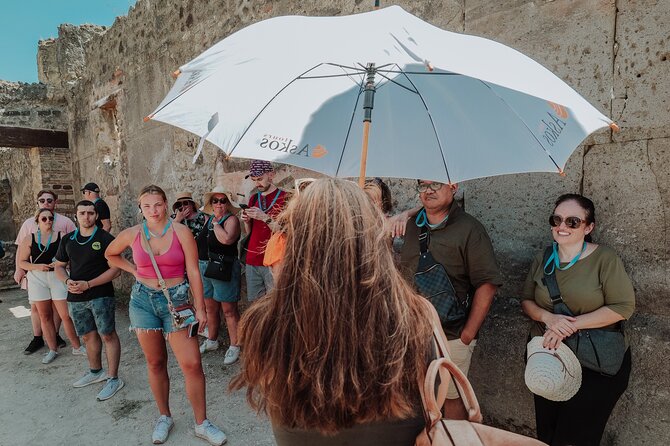
Pompeii is famous, which also means it’s busy. The tour includes “Pompeii Express” entry tickets, built to help you bypass some of the waiting so you can get moving into the park.
Once you’re in, the structure is what makes the day feel doable. You get a full-on guided introduction in Pompeii (about 2 hours total at the Pompeii Archaeological Park), then the route turns into a walk of specific stops that sketch the city’s layout and key buildings.
One of the best parts is that the guide doesn’t just point at walls. You’ll be shown how the streets and buildings connect—so you can look at a forum space, then quickly place it in the life of a Roman town.
Pompeii stop-by-stop: what you’ll see (and why it matters)
Here’s how the Pompeii portion is designed to help you understand the city in a short time.
- Basilica (Basilica)
This is where civic life sat up and ran. In a short stop, you’ll get the big-picture function of a basilica—part courthouse, part meeting ground—so the ruins feel purposeful, not random.
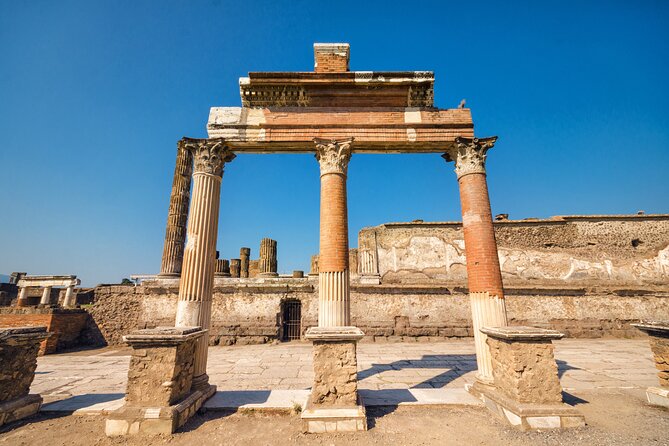
- Forum (Foro de Pompeya)
The forum is the city’s social engine. You’ll see the space that hosted public business and everyday community activity, helping you connect the idea of Pompeii as a living town rather than a disaster site.
- Via dell’Abbondanza (Abbondanza Street)
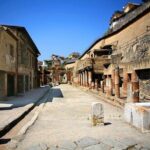
This long street line helps you picture how people moved between neighborhoods and public spaces. Even in brief time, it gives you a sense of scale—Pompeii feels large when you’re walking its main routes.
- House of Menander
This stop is a strong “how Romans lived” moment. You’ll be guided through what a house like this signals about wealth, design, and domestic priorities.
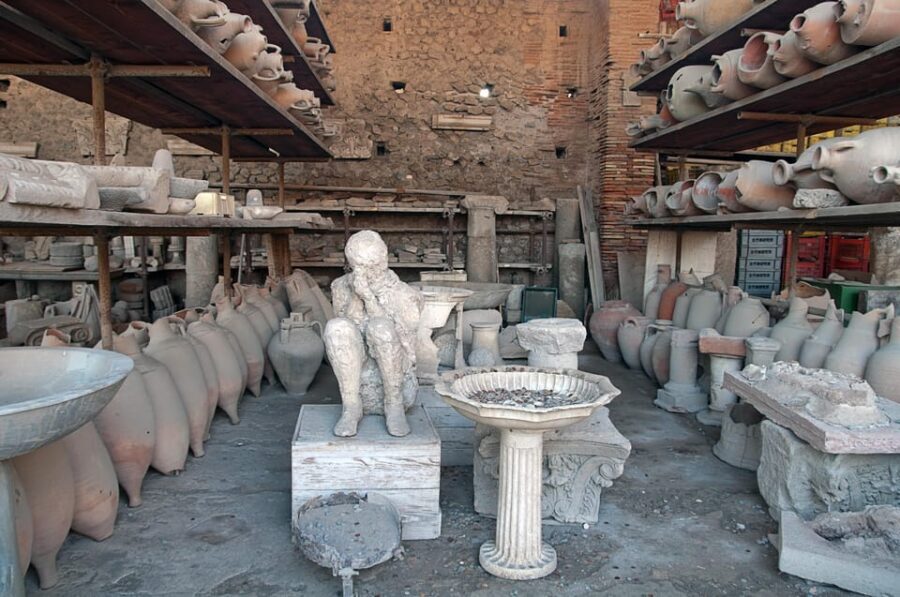
- Granaries of the Forum
Food supply is power. Seeing the grain storage connected to the forum area helps you understand how urban life depended on systems—not just luxury homes.
- Stabian Baths (Terme Stabiane)
A bath stop turns Pompeii from public politics into daily routines. Baths weren’t just about washing; they were also social hubs, and the layout helps you grasp that.
- Lupanar
This is a famously controversial building type, and the guided framing is what makes it useful instead of awkward. You’ll get context about what the structure represents in a Roman city.
- House of the Faun
One of Pompeii’s well-known homes. The guide’s job here is to help you read what you’re looking at—courtyard scale, building intent, and why certain features were valued.
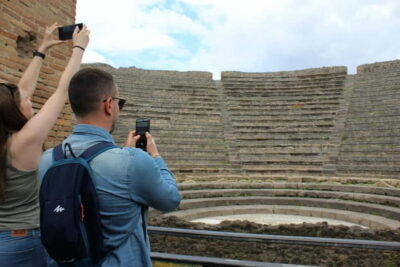
- Odeon – Teatro Piccolo
A smaller theater makes Pompeii’s entertainment scene feel more complete. Even briefly, it helps you see how culture fit into everyday schedules.
- Teatro Grande (Great Theatre)
The big stage closes the Pompeii loop by showing the city’s public performance side. It’s a quick stop, but it’s a strong final image for the day’s Pompeii story.
And remember: after this set of short stops, the entire Pompeii experience is still built around that key chunk of guided time inside the archaeological park. You’re meant to leave with a mental map.
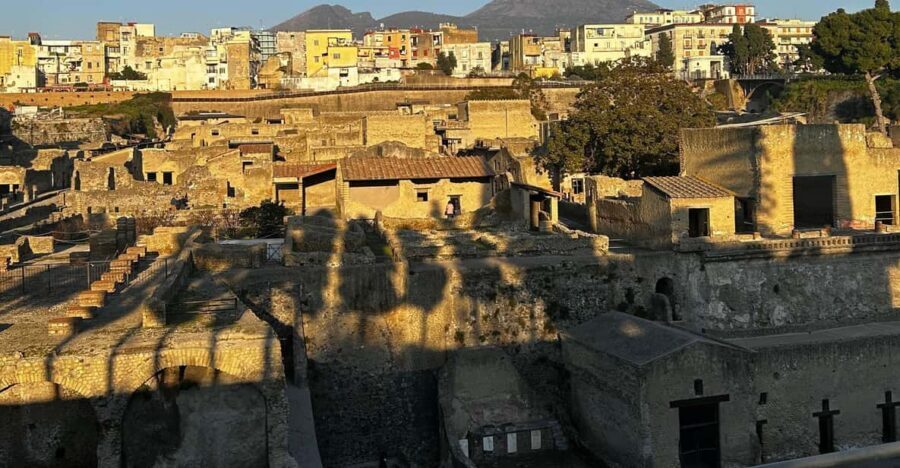
Herculaneum’s ruins: smaller scale, big emotional impact
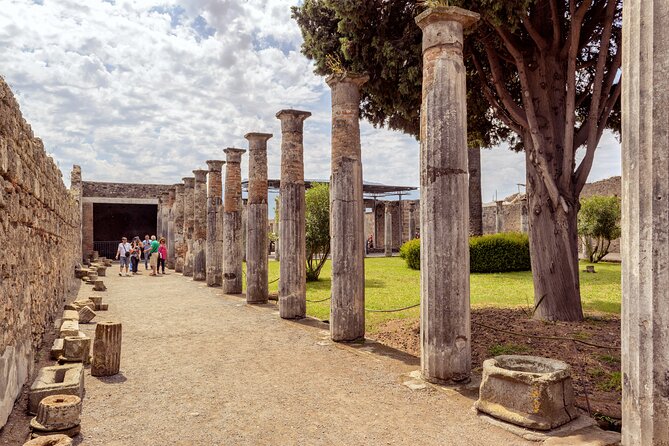
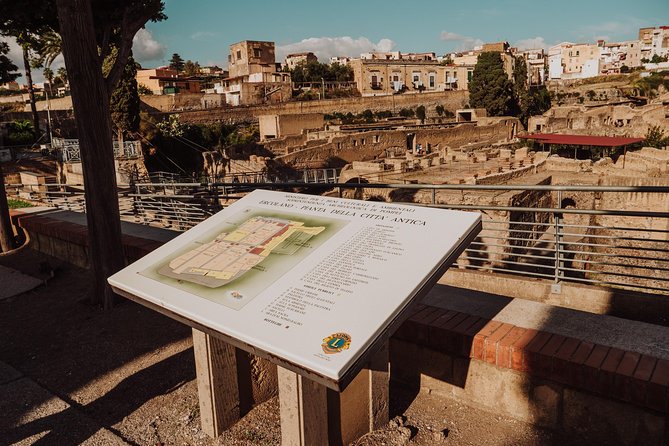
After Pompeii, the tour shifts to Herculaneum with another guided park visit (about 2 hours at the Archaeological Park of Herculaneum). Tickets for Herculaneum are included (€16 per person).
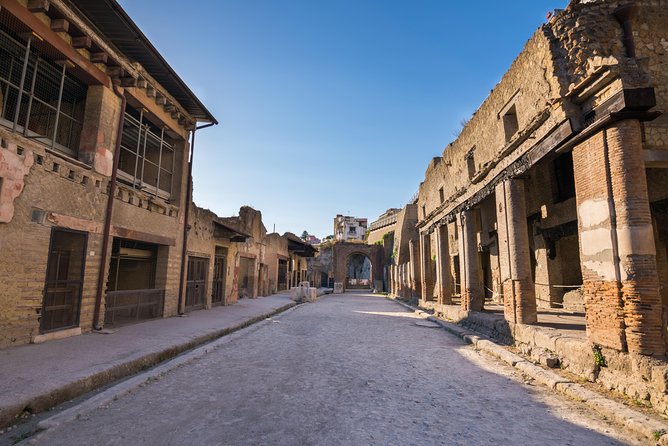
What I like about that choice is the contrast. Pompeii hits you with major set pieces and a wide city feel. Herculaneum is often easier to connect to the human scale because the town is smaller and the preserved spaces feel closer to daily life.
Herculaneum stop-by-stop: the “city you could step into”
The Herculaneum route is a sequence of short house and building stops that highlight daily routines, social structure, and the way homes were built for Roman living.
- House of the Deer
A focused home stop gives you a quick look at domestic design and status cues.
- Terrace of M. Nonio Balbo (La Terrazza di M. Nonio Balbo)
Terraces explain how light, views, and social space mattered. Even as a brief stop, it helps you understand how wealth owners used outdoor areas.
- College of the Augustales
This is a social-institution stop. You’ll see how associations and civic groups shaped community life.
- Casa del Rilievo di Telefo
Sculptural decoration and home identity come into play here, letting you connect art and personal display inside domestic space.
- Partem Domus lignea – Casa del Tramezzo di Legno (Wooden Partition House)
This is a standout type of stop because it points out that Herculaneum doesn’t just survive in stone forms. The way the home is framed helps you see preservation in a different light.
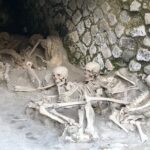
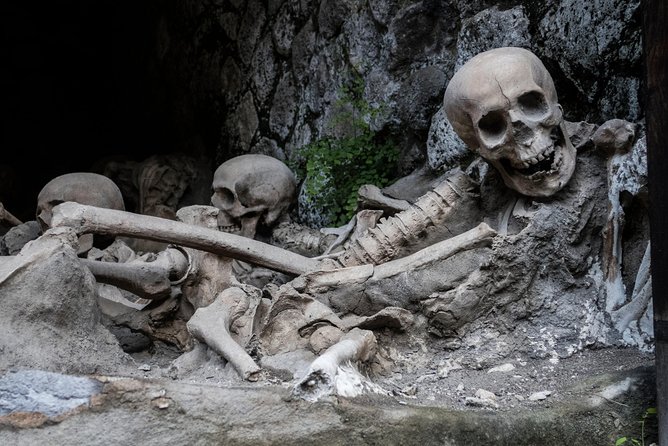
- House of the Skeleton
A heavy stop, but that’s where the guide’s role matters most. Context helps you understand why the remains matter to the story, not just the shock factor.
- Central Thermae
The bath complex brings back that sense of routine and social mixing. It also helps you compare baths in Herculaneum versus what you saw at Pompeii.
- House of the Black Salon (House of the Salon of Nero)
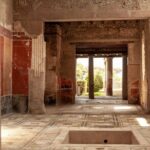
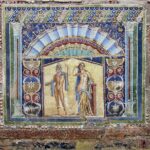
A strong visual stop that helps you think about taste, materials, and the role of color and setting in Roman interiors.
- Casa Sannitica
Another home stop that supports the idea of Herculaneum as a lived-in community, not a single famous landmark.
- Casa del Bel Cortile
Courtyard homes tell you a lot about circulation and how families used space day-to-day.
- House of the Grand Portal
This closes the set with a building façade theme—so you finish with a sense of how homes announced status to the street.
If Pompeii is about public life and big city landmarks, Herculaneum is about how it felt to be inside the routines—homes, baths, and community spaces in tight form.


The archaeologist guide: why you feel oriented, not overwhelmed
A big reason this tour earns such high praise is how guides handle the job. People single out guides such as Rafael, Gennaro, Michele, Vincenzo, Diego, Giulia, and others for staying engaging and for pacing the explanations to match what you can actually see.
For you, the value is orientation. Archaeology is tough if you’re looking at a site with no storyline. Here, you’re set up to recognize patterns fast: civic spaces versus private rooms, public entertainment versus daily routines, and how the city plan affects what you understand.
You also get a sense of humor in the delivery. That’s not fluff. It helps when you’re absorbing heavy topics and walking between stops in a limited time window.
Timing, pace, and how to avoid a tired-foot day
This excursion runs about 7 hours. That’s long enough to feel like a real day trip, but short enough that you’ll be in motion for much of it.
Because many stops are tightly timed (think 5 to 10 minutes per spot in Pompeii and multiple quick views in Herculaneum), you should plan to move with the group. This isn’t a sit-and-stare tour. It’s a “see, learn, connect, then move” format.
Here’s how I’d prep for that kind of day:
- Wear comfortable shoes since you’ll be walking between frequent points.
- Bring water and plan a snack buffer even though meals and drinks aren’t included.
- If you love photos, use the guide’s stop points to aim for quick shots rather than trying to shoot everything while moving.
There’s also a note in the tour info about temperature checks and mask use during site entry rules at the time this information was provided. Plan like they could ask for a mask, and have one packed.
Price and value: does $173.27 make sense for two parks?
At $173.27 per person, this is not a budget pick. But it’s also not just a bus ticket with a map.
What you get for the money is the combination:
- Archaeologist guide at Pompeii and Herculaneum
- Pompeii admission tickets included (Pompeii Express entry)
- Herculaneum entrance included (€16 per person)
- Professional driver and transportation by minibus
- Fast-track style entry help for Pompeii to reduce time in line
If you DIY both parks, you’d usually pay for tickets, spend time figuring out transport, and lose the guided interpretation that saves you from wandering aimlessly. Here, the guide compresses the learning curve so you spend your time inside the sites rather than on logistics.
One practical tip: this tour tends to be booked fairly ahead (around 64 days on average). If you’re traveling in a busy season, grabbing your spot earlier can be smart.
Who this small-group Pompeii and Herculaneum day is best for
This is a strong match if you:
- Want one-day coverage of both major sites without turning your day into a routing puzzle
- Enjoy guided context more than self-reading ruins
- Like small-group settings (max 20) where you can hear explanations and stay together
It may be less ideal if you:
- Want lots of free time to wander without structure
- Prefer long, slow museum-style viewing at each building
- Plan on skipping the guide and only using audio
Quick practical notes before you go
- Meeting point: Starhotels Terminus, Piazza Giuseppe Garibaldi, 91, Naples.
- Group size: maximum 20 travelers.
- Meals and drinks: not included, so plan to grab something on your own during gaps in the schedule.
- Service animals are allowed.
- Confirmation is received at booking.
Should you book this Pompeii and Herculaneum excursion?
Yes—if your goal is a well-run, guided day that lets you see two core sites without the planning headaches. The biggest reason to book is the pairing of small-group pacing with an archaeologist-led explanation, which turns a chaotic place into something you can follow.
If you’re the type who needs long quiet time in one spot, you may feel rushed by the short-stop structure. For most people, though, this is a practical way to get strong coverage of Pompeii’s public-city highlights and Herculaneum’s more human-scale ruins in a single day.
FAQ
How long is the Pompeii and Herculaneum excursion?
The tour lasts about 7 hours.
Do they pick you up in Naples?
Yes. Pickup is offered, and the meeting point is Starhotels Terminus in Naples.
How big is the group?
The tour has a maximum of 20 travelers.
Is Pompeii fast-track or skip-the-line entry included?
Yes. Pompeii Express entry tickets are included.
How long do you spend at Pompeii and Herculaneum?
You’ll spend about 2 hours at Pompeii and about 2 hours at Herculaneum.
Are entrance fees included?
Yes. Pompeii entry tickets are included, and Herculaneum entrance is included at €16 per person.
Are meals included?
No. Meals and drinks are not included.
What are the site entry rules mentioned by the operator?
The information provided notes mask use was mandatory and that body temperature detection could be required for entry.
What is the cancellation policy?
You can cancel for a full refund if you do so at least 24 hours before the experience start time. If you cancel within 24 hours, the amount paid is not refunded.