REVIEW · POMPEII
Half-Day Exclusive Private Tour of Pompeii and Herculaneum
Book on Viator →Operated by LivTours · Bookable on Viator
Pompeii and Herculaneum in one tight block. This private half-day plan is built to help you see two major Roman sites without losing hours to lines and wandering. You’ll get skip-the-line entry at both places, plus a guide who can explain what you’re actually looking at: city planning, daily life, and why the ruins survived in such different ways. One thing I really like is the pacing: 4 hours sounds short, but the structure is clear, so you don’t feel like you’re sprinting blindly.
The other big plus is the human factor. You’re not stuck with a busload rhythm; you get full guide attention, and the tour can flex to real life—like late trains. The main drawback to weigh is the premium price (over $4,655 per person), so this one makes the most sense if you value a private guide and can justify the cost for your group size and interests.
In This Review
- Key things to know before you go
- How the half-day private plan saves you from Pompeii chaos
- Pompeii Archaeological Park: streets, Forum life, and the drainage
- Getting to Herculaneum: short transfer, different archaeological feel
- Herculaneum Parco Acheologico di Ercolano: wood, food, and mosaics
- Private guide payoff: tuning the pace for families and first-timers
- Price, time, and value of skip-the-line private access
- Should you book this Pompeii and Herculaneum private tour?
- FAQ
- Is this a private tour?
- How long is the tour?
- Where does the tour start and end?
- Does the tour include tickets and skip-the-line entry?
- Are transfers between Pompeii and Herculaneum included?
- What language is the tour offered in?
- How much of the day is spent at each site?
- Can most travelers participate?
- Is there a mobile ticket?
- What’s the cancellation policy?
- How does confirmation work after booking?
Key things to know before you go
- Skip-the-line at both sites: less time waiting, more time learning.
- One guide, two worlds: Pompeii feels sprawling; Herculaneum feels intimate and preserved.
- Transfer between Pompeii and Herculaneum: you won’t be solving transport in between.
- Pompeii highlights include the Forum and residential areas: you’ll see how public life and private life fit together.
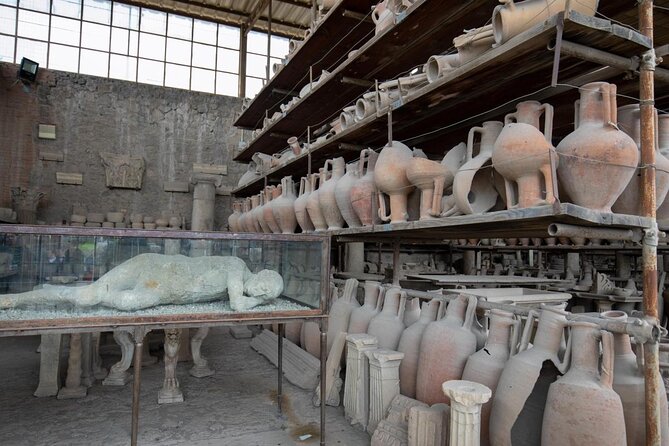
- Herculaneum’s preservation is the star: conditions preserved delicate materials, not just stone.
- Family-friendly pacing is possible: your guide may build in breaks and keep kids engaged.
How the half-day private plan saves you from Pompeii chaos
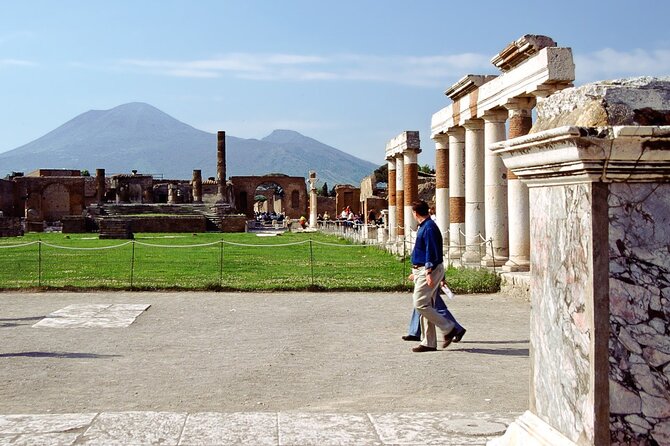
Two sites, one morning or afternoon. That’s the whole idea, and it works best when the tour is organized down to the minute. Here, you start at Via Villa dei Misteri, 1 in Pompeii, then end at the Archaeological Park of Herculaneum on Corso Resina, 187. That matters because you’re not spending your time backtracking or figuring out how to get from one park to the other.
The duration is about 4 hours, with around 2 hours at Pompeii and 2 hours at Herculaneum. If you’ve ever visited Pompeii on your own, you know the problem: lines, crowds, and the feeling that you’re only seeing what’s closest to the entrance. A private format changes the experience. I like that you’re not just moving through rooms and streets; you’re learning how to read the city, including the logic behind what’s laid out in front of you.
You’ll also have transportation between the sites included. Even though Pompeii and Herculaneum are close (about 5 miles apart), that distance can still eat time if you’re moving on your own. The tour removes that friction.
One practical thought: Pompeii and Herculaneum are both archaeological parks with lots of walking. Fast pace is part of the deal, so wear comfortable shoes and plan for uneven ground. The upside is that your guide’s explanations help the walk feel productive rather than repetitive.
If you're still narrowing it down, here are other tours in Pompeii we've reviewed.


Pompeii Archaeological Park: streets, Forum life, and the drainage
Pompeii is the headline, and the tour uses that time well. You begin with skip-the-line access directly into the excavations, which is exactly what you want if you’re trying to fit a lot into a half-day.
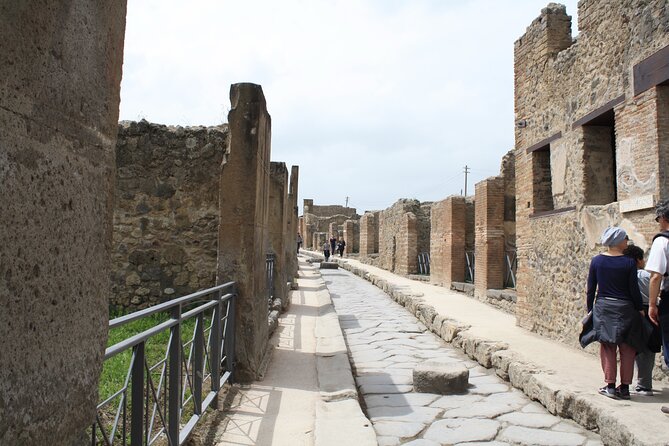
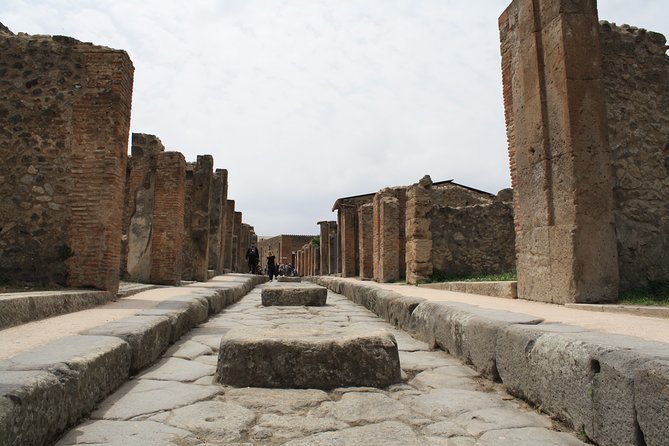
What I like about the Pompeii portion is that it’s not just a list of ruins. The guide is set up to explain how the city worked, including road mapping and residential planning, and even the sewage systems—the kind of detail that turns ruins from scenery into a living place. You’re also guided through the commercial side of town, including the shops along the streets. That’s a great way to understand that Pompeii wasn’t just houses and temples; it was trade, services, and daily transactions.
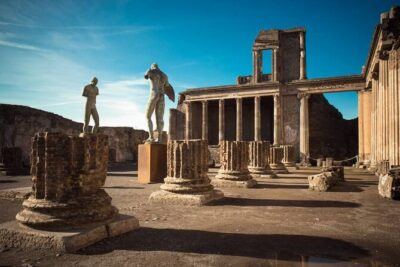
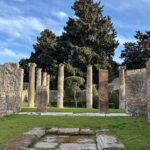
Then you’ll hit the Forum of Pompeii, described as the pulse of the city—where residents practiced religious life and also handled economic and commercial activity. If you want one anchor point to keep Pompeii organized in your head, it’s this. The Forum gives you a mental center, so the surrounding streets and buildings start to make more sense.
You’ll also pass the ancient basilica, noted as a preserved architectural prototype of the Christian basilica. That’s useful because it shows how later architectural ideas can trace back to earlier civic layouts.
Finally, you’ll walk through residential neighborhoods, where your guide connects what you see to how private residents likely lived and loved. This is where a guide pays off most. Without context, houses can look like boxes of stone. With context, they become evidence of how people cooked, slept, socialized, and organized their domestic routines.
Possible drawback: Pompeii can feel big, and 2 hours can go by quickly. If you’re the type who likes to stop every few minutes and read every sign, this itinerary may feel like it moves on purpose. The benefit is that you’ll leave with a clearer story instead of a scattershot set of photos.
Getting to Herculaneum: short transfer, different archaeological feel
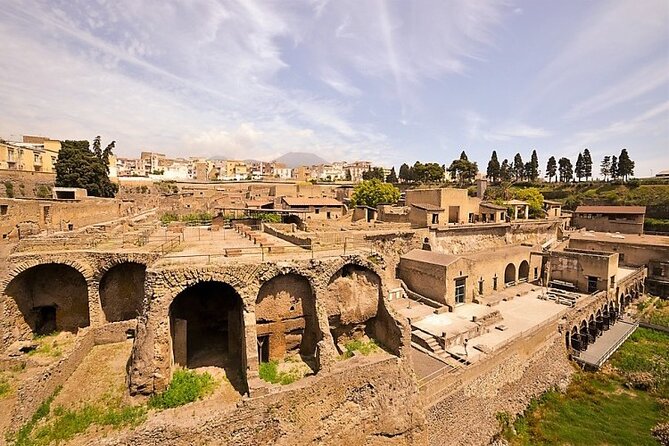
After Pompeii, you switch gears and head to Herculaneum. The tour includes a transfer, and the quick ride matters because it resets you mentally. Pompeii is dramatic and extensive; Herculaneum is smaller, but the preservation is often the reason people say it feels more personal.
The tour frames Herculaneum as being about equal in importance, with a major difference: volcanic material helped preserve more than stone. That means you’re not only looking at walls and streets. You may get to see impressions and remnants that are far more delicate—things like wooden elements and other natural substances. Even the idea of seeing the very beds and food remnants gives you a clear expectation: this park can feel like the past left the room only minutes ago.
Also, because you’re going in a guided loop, you’re more likely to follow a route that matches your interests. The tour description notes that attractions you see in Herculaneum can depend on the day’s route. So if you love mosaics, bathing culture, or standout houses, a good guide can steer you toward what fits best.
One thing to keep in mind: because the route can vary, don’t build your day around one single must-see item in Herculaneum unless you’re already familiar with what’s typically offered. The trade-off is that you get a guided plan designed for meaningful coverage rather than a rigid checklist.
Herculaneum Parco Acheologico di Ercolano: wood, food, and mosaics
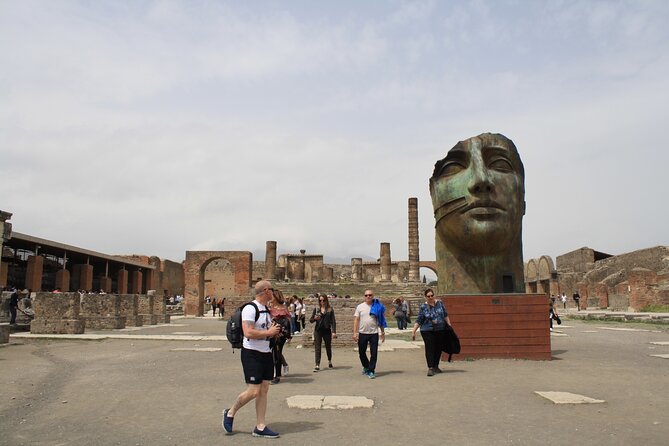
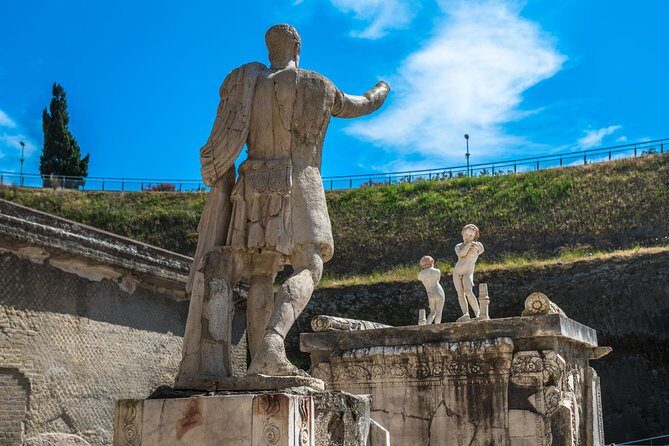
Herculaneum is often called the better-preserved counterpart to Pompeii, and in this tour the reason gets explained while you’re standing there. That is a big deal. Preservation isn’t just a trivia point—it shapes what you understand about daily life.
You’ll spend about 2 hours in the Parco Acheologico di Ercolano with your guide. Expect to see major sights such as the Thermal Baths and mosaic floors, plus notable residences including the House of Galba and the Samnite House (these are listed as attractions you may see, depending on route). The thermal baths are a strong choice for visitors because they connect art and daily routine. Mosaics work the same way: they’re decorative, but they also reveal taste, wealth, and the care people put into shared spaces.
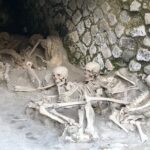
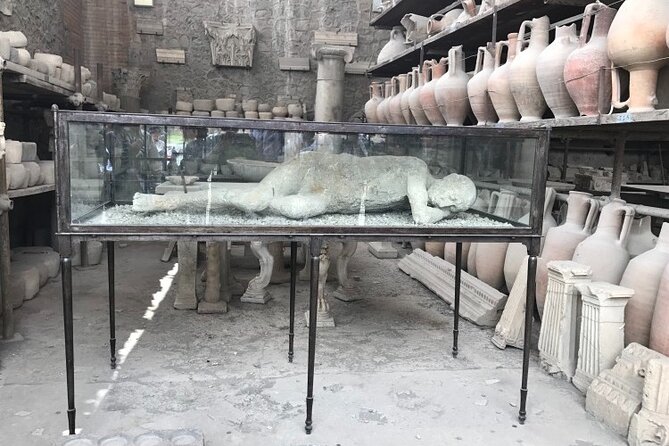
The preservation details can make Herculaneum feel emotionally different from Pompeii. The tour specifically highlights that the volcanic material helped preserve delicate materials, including wood and other natural substances. It also points to seeing things like beds and food remnants left behind. Even if you’re not an archaeology expert, those elements help you picture what “home” looked like beyond walls.
If you’re visiting with kids or teens, this can be a win. In one account of the tour, Carla (a guide you might encounter) kept a family of five engaged by asking what the kids liked and then pointing them to those interests on site. That type of guidance is especially useful in places where the physical objects can be small or fragile. Kids can easily lose focus in a museum. But in a guided walk, the guide helps you notice what matters.
Possible drawback: because Herculaneum is about delicate remains, you might find parts of the site less photo-friendly than Pompeii. That’s not a downside of the tour; it’s the nature of preservation and viewing conditions. The value comes from understanding what the site is telling you.
Private guide payoff: tuning the pace for families and first-timers
A private archaeological tour is more than a quieter experience. It’s the difference between collecting facts and building understanding.
Here’s what you should look for in a private guide setup:
- Context first: your guide won’t just point out ruins; they’ll explain how the city layout worked (roads, neighborhoods, civic centers).
- Details that connect: sewage systems, commercial streets, and domestic spaces are linked to daily life rather than treated as isolated oddities.
- Pacing you can handle: the itinerary stays tight, but the guide can also manage small needs.
One review detail stands out: Carla was patient when a family was late due to a train delay, waiting around 45 minutes. That kind of flexibility can matter more than people expect, because southern Italy transit hiccups are real. The lesson for you is simple: still plan to arrive early, but don’t assume every schedule problem means your day is ruined.
That same account also mentions a family with preteens and teens, where the guide stayed engaging and made time for bathroom and snack breaks. Again, this is what you’re paying for with private access: a guide who can adapt without turning the day into a rigid sprint.
Language is English, and confirmation comes at booking. If you prefer a guide who can answer questions in real time, private formats tend to deliver better back-and-forth than group tours.
Who this fits best:
- First-timers who want the big names (Pompeii Forum area and key houses in Herculaneum).
- People who hate wasting time in lines.
- Families who need guidance that works for different attention spans.



Price, time, and value of skip-the-line private access
Let’s talk about the elephant in the room: $4,655.67 per person is not casual spending. So how do you decide if it’s worth it?
The key is that this price bundles several high-value items:
- Private guide time across both parks (not just one).
- Skip-the-line entrance for Pompeii and Herculaneum.
- Transfer between sites, saving you time and coordination.
- Tickets included for both stops.
When you break it down that way, the cost starts to look less like paying for sightseeing and more like paying for reduced friction. In Pompeii, the biggest frustration is waiting and crowd navigation. If you can remove those, you get your brain back. Instead of scanning signage and sidestepping tour groups, you’re learning what you see and keeping track of the story.
Still, I’d be honest with you: if you’re a solo traveler or a couple who would be happy with a standard group entry, a private tour may feel overpriced. This is often better value when:
- You’re traveling as a small group that really benefits from private attention.
- You want a tailored pace and explanations geared toward your interests.
- Your group includes younger travelers who do better with interactive guidance.
Time also matters. You get about 2 hours at each site, which is enough to feel oriented, but not enough to linger for hours. If your dream day is slow museum-style reading, you may feel rushed. If your dream day is sharp, meaningful coverage with expert context, the timing can work very well.
Should you book this Pompeii and Herculaneum private tour?
Book it if you want to treat Pompeii and Herculaneum like more than photo stops. The combination of skip-the-line access, a private guide, and the switch from Pompeii’s civic and commercial life to Herculaneum’s unusually preserved remains is a smart half-day plan.
Don’t book it if you’re trying to do this as cheaply as possible, or if you need long, unstructured wandering time. This tour is designed for movement and explanation, not for endless lingering.
My practical advice for the best outcome:
- Arrive a bit early at the meeting point in Pompeii so you don’t lose momentum.
- Wear comfy shoes and expect uneven ground.
- If you care most about mosaics, baths, streets, or domestic life, tell your guide early so the route and explanations match your interests.
If you match that style, this is one of those rare half-days that feels organized, not stressful.
FAQ
Is this a private tour?
Yes. It’s a private tour/activity, meaning only your group will participate.
How long is the tour?
The duration is approximately 4 hours.
Where does the tour start and end?
It starts at Via Villa dei Misteri, 1, 80045 Pompei NA, Italy and ends at the Archaeological Park of Herculaneum, Corso Resina, 187, 80056 Ercolano NA, Italy.
Does the tour include tickets and skip-the-line entry?
Yes. Skip-the-line entrance is included for both Pompeii and Herculaneum, and admission tickets are included.
Are transfers between Pompeii and Herculaneum included?
Yes. The tour includes transfer from Pompeii to Herculaneum.
What language is the tour offered in?
It’s offered in English.
How much of the day is spent at each site?
You’ll spend about 2 hours at Pompeii Archaeological Park and about 2 hours at Parco Acheologico di Ercolano in Herculaneum.
Can most travelers participate?
Most travelers can participate.
Is there a mobile ticket?
Yes. The tour includes a mobile ticket.
What’s the cancellation policy?
Free cancellation is available. You can cancel up to 24 hours in advance for a full refund.
How does confirmation work after booking?
Confirmation will be received at the time of booking.