REVIEW · SORRENTO
Private Skip-the-line Pompeii & Mt. Vesuvius Tour from Sorrento
Book on Viator →Operated by IAMME IA! - Gray Line Amalfi Coast · Bookable on Viator
Pompeii plus Vesuvius is a heavy combo. This private, skip-the-line day from Sorrento pairs a guided Pompeii walk with priority access to the crater edge. Hotel pickup and drop-off makes it easy to start, and I like how priority access keeps you moving instead of waiting in crowds. One thing to plan for: the Pompeii walking is real, and the Vesuvius path is uneven, so comfy shoes are non-negotiable.
In This Review
- Key highlights at a glance
- Door-to-door pickup from Sorrento (and why it matters)
- Skip-the-line Pompeii: what a guided walk really buys you
- Forum highlights: the city’s center, explained fast
- Via dell’Abbondanza: the main street vibe
- Stabian Baths: Roman leisure with real damage
- Casa del Fauno: wealth, mosaics, and a full block
- The Lupanar: uncomfortable, informative, and very human
- Teatro Grande and the Basilica: how power looked in public
- Vesuvius National Park: crater edge time and what to expect
- Timing reality: why this day feels packed
- Price and value: is $635.61 per person worth it?
- Who this private tour fits best
- Small, smart tips before you go
- Book it or skip it? My take
- FAQ
- Is hotel pickup included on the Pompeii and Vesuvius tour?
- How long is the tour?
- Is this a private tour?
- Do I get skip-the-line or priority access?
- Are tickets included?
- Will I have an English-speaking driver and guide?
- What’s included and what’s not?
- Where do I start the tour?
- Should I reconfirm my pickup time?
- What is the cancellation policy?
Key highlights at a glance
- Private door-to-door pickup in Sorrento so you spend less time coordinating transit
- Priority access at Pompeii and Vesuvius to protect your time on the ground
- Guided Pompeii route through major sites like the Forum, Jupiter Temple, and the Baths
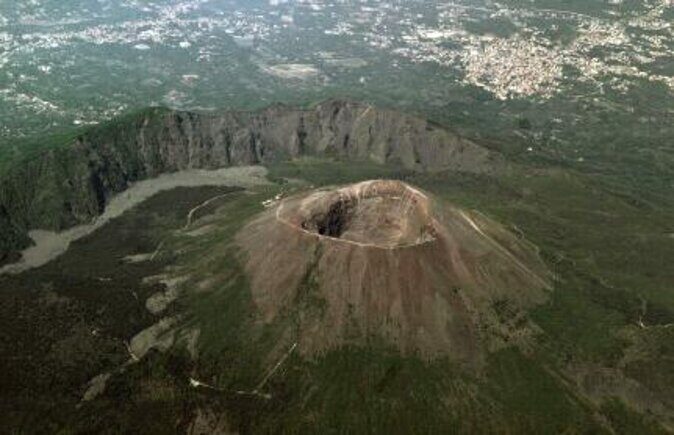
- Up-close crater-edge views at about 1,280 m with a short, scenic walk
- A tight, time-managed itinerary with many stops and short viewing windows
- Food and drinks not included (you’ll want to plan your own breaks)
Door-to-door pickup from Sorrento (and why it matters)
This is built as a private day. You’re picked up from your hotel in the Sorrento area, and you’re brought back after the tour by private vehicle. That matters because Pompeii and Vesuvius are both time-sensitive: you don’t want your day wonky due to buses, transfers, or last-minute tickets.
You’ll also get a mobile ticket, plus priority access arrangements. In practice, this means you’re spending your energy on the ruins and the volcano, not on logistics. If you like a day that feels controlled, this format works.
The duration is about 8 hours. That’s enough time to see the big moments, but not enough to wander slowly. If you’re the type who wants to stop for photos every 30 seconds, plan to move with the group and then slow down where you find your favorite corner.
Other Pompeii and Vesuvius combo tours we've reviewed at Vesuvius & the Bay of Naples


Skip-the-line Pompeii: what a guided walk really buys you
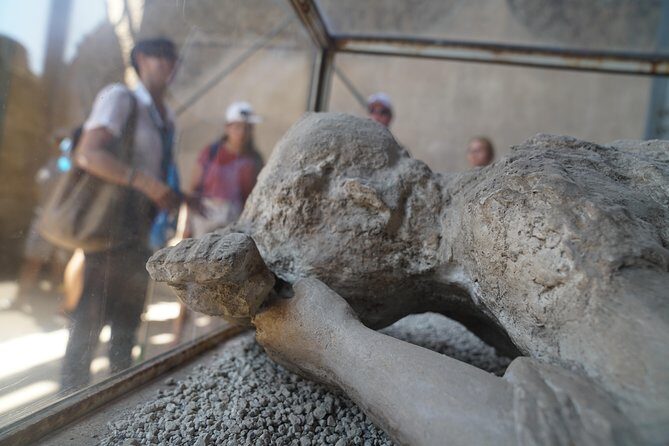
Pompeii is one of those places where being on your own can feel like a puzzle with missing pieces. With a private guide, you get a clear storyline as you move through the city: what you’re seeing, why it matters, and how daily life fit together before 79 A.D. turned it into ash and pumice.
You’ll start with about 2 hours in the Archaeological Park of Pompeii, with an admission ticket included. That’s a good length for a first visit because you hit major zones without feeling like the day disappears.
The tour is private, and the driver/guide operate in the language you select (English is available), while the driver speaks English or Italian. That language consistency helps because Pompeii details can get technical fast—especially with architecture and Roman civic life.
Forum highlights: the city’s center, explained fast
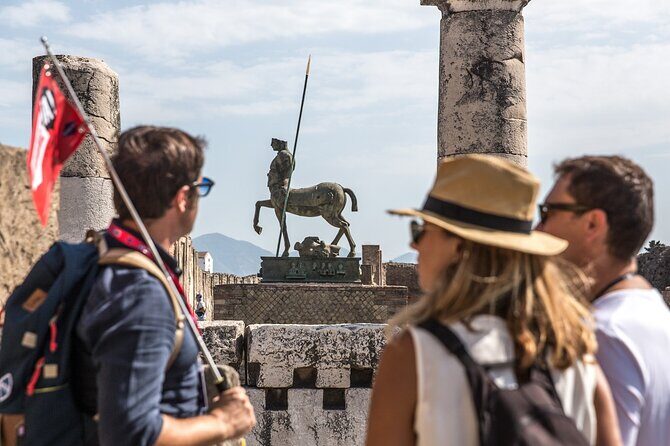
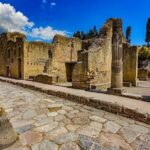
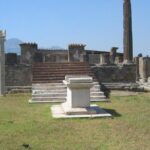
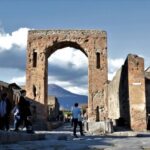
The Pompeii route is very “core first.” You’ll pass through the Foro de Pompeya, which functioned as the heart of civic life—public buildings, justice, business, markets, and worship.
Right after that, you’ll visit the Tempio di Giove Capitolino, the Temple of Jupiter on the north side of the Forum. The standout detail here is how the temple connects to the visual power of Roman rule: when the colony was founded (80 BC), it was renovated into a Capitolium-style space with statues of Jupiter, Juno, and Minerva placed high so people in the Forum could see them. Even with a short stop, this is the kind of context that makes the ruins click.
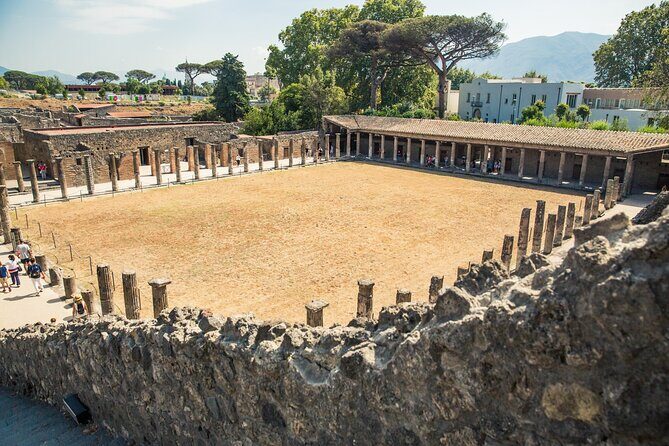
Then you’ll also see the Macellum. This is the city’s market hall, a tuff quadriporticus with an elevated worship space. The description you’ll hear usually focuses on how food trade, meeting spaces, and imperial cult ties lived side by side. That is the Pompeii surprise: it’s not just houses and streets. It’s administration, commerce, and religion in one compact grid.
Time is tight—these Forum stops are about 10 minutes each—but for many visitors, that’s the point. You’ll understand what matters most before you decide what you want to linger on later.
Via dell’Abbondanza: the main street vibe
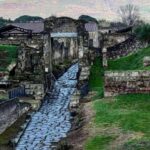
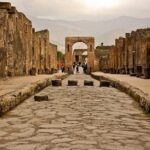
You’ll walk through Via dell’Abbondanza, Pompeii’s ancient main street (a decumanus maximus). It ran east to west from the Forum toward the Porta Sarno.
What I like about this part is that it gives you the feel of the city. This street was packed with shops, workshops (officinae), snack bars, and places to buy food and drink. In other words, you get a built-in mental picture of noise, movement, and trade—so Pompeii doesn’t feel like an empty museum.
It also works as a pacing reset between the Forum and the residential and leisure stops. If you’re tempted to rush, slow down here for a minute. Street-level Pompeii is where you really grasp scale.
Stabian Baths: Roman leisure with real damage
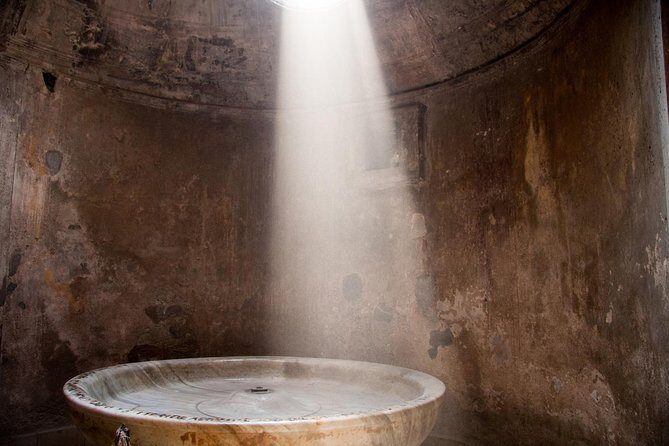
Next up are the Stabian Baths (Terme Stabiane), behind the Temple of Jupiter. These date to the years after the colony was founded by Sulla (80 BC). One useful detail the guide will likely emphasize is how Roman bathing wasn’t just hygiene—it was a multi-room ritual.
The men’s side includes a changing room (apodyterium) that doubles as tepidarium, then frigidarium (cold baths), and calidarium (hot baths). The building also took serious damage during the earthquake of 62 AD, which is a key reminder: the eruption wasn’t the only disaster to hit Pompeii. You’re seeing layers of history—some dramatic, some gradual, all part of the story.
The stop is about 10 minutes. You won’t have time to do a deep restoration study, but you’ll get the layout in your head, and that makes the ruins more readable.
Other tours departing from Sorrento we've reviewed at Vesuvius & the Bay of Naples




Casa del Fauno: wealth, mosaics, and a full block
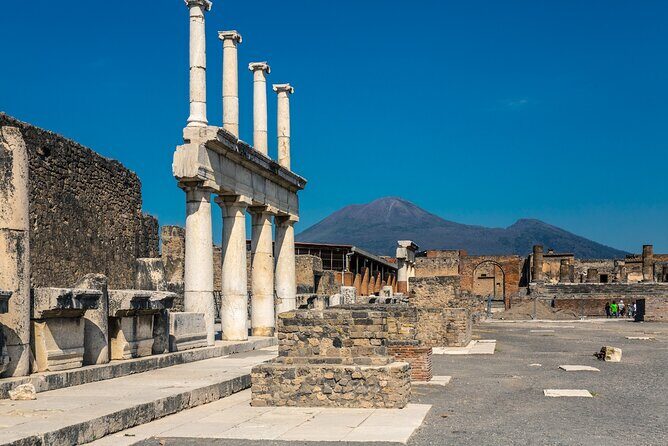
The Casa del Fauno is one of the biggest and most luxurious private residences in Pompeii, covering an entire city block. The name comes from a famous bronze statue of a dancing faun found in the atrium.
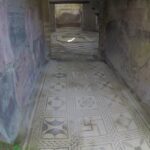
This house is most famous for the Alexander Mosaic, depicting Alexander the Great’s battle against Darius III of Persia. Even if you’ve seen similar images before, seeing it referenced in context—along with the house’s two peristyle gardens and floor mosaics—turns it from an art fact into a statement about status.
You’ll also hear it belonged to Quintus Poppaeus Sabinus of the Poppei family, relatives of Empress Poppea Sabina (Nero’s second wife). That kind of connection helps you understand why Pompeii had elite homes alongside common structures. Stop time is about 10 minutes, so treat it like a “spotlight moment,” not a long museum visit.
The Lupanar: uncomfortable, informative, and very human
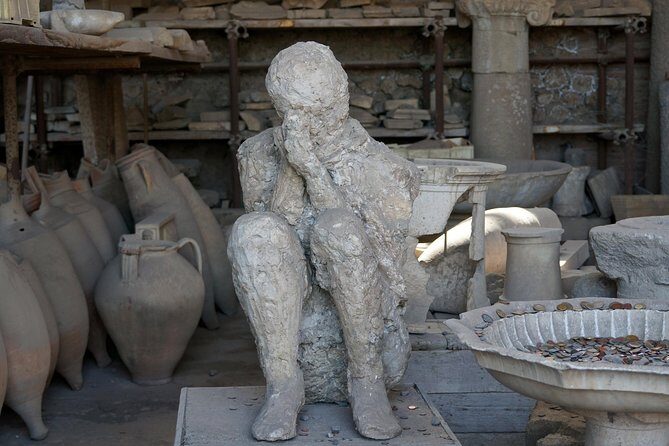
Then you’ll reach the Lupanar (Lupanare Grande), Pompeii’s most famous brothel. It’s known for erotic wall paintings, and the name simply means brothel in Latin.
This stop can be a bit jarring, especially if you’d rather keep your tour family-friendly. But it’s also one of the more human parts of Pompeii: it shows that even in a highly regulated Roman city, people had sex work, transactions, and clear signage in everyday spaces.
The guide will also cover how the prostitutes were often Greek and Oriental slaves, and that payment ranged between two and eight asses, with wine costing one as. That’s a reminder that economics and power show up in the smallest corners of the city too.
The stop is about 10 minutes. If you’re sensitive to the subject matter, just know it’s part of the standard route.
Teatro Grande and the Basilica: how power looked in public
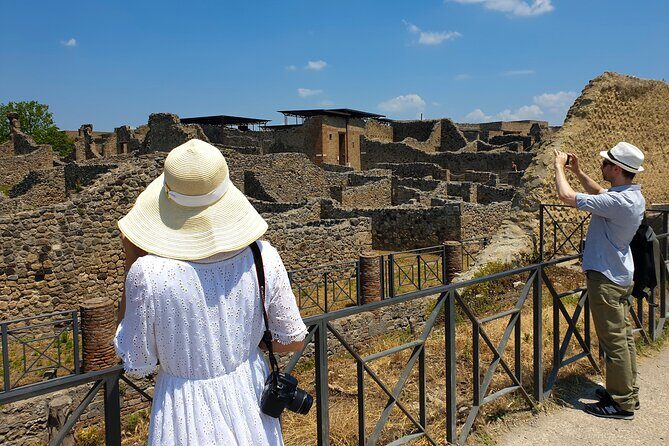
The Teatro Grande is the Large Theater on a hill slope, built by the Romans using the natural depression of the mountain to create a big auditorium divided into sectors. The theater hosted tragedy performances with Greco-Roman traditions.
This stop helps you see Pompeii as a place of entertainment and shared culture—not just civic order.
Right after that, you’ll see the Basilica, around 1,500 square meters, one of the Forum’s most sumptuous buildings. Its space was used for business and administration of justice. Think of it as a Roman “work and law” hub, which makes the Forum stops feel less random.
Again, it’s a short stop (about 10 minutes), but by now you’ll recognize the pattern: Pompeii is organized, planned, and very intentional about where people met and where decisions got made.
Vesuvius National Park: crater edge time and what to expect
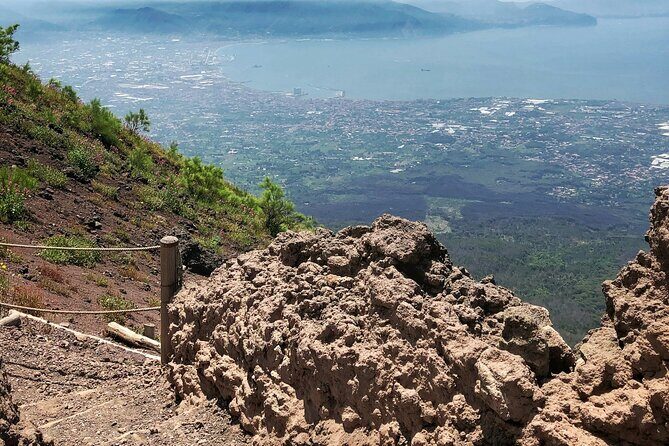
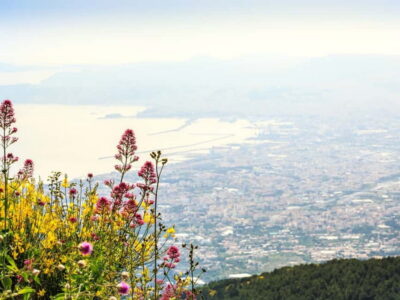
After Pompeii, you head to Vesuvius National Park. The tour includes drop-off at about 1,000 meters elevation for about 1 hour. This helps you acclimate your legs and catch your first views over the Gulf of Naples.
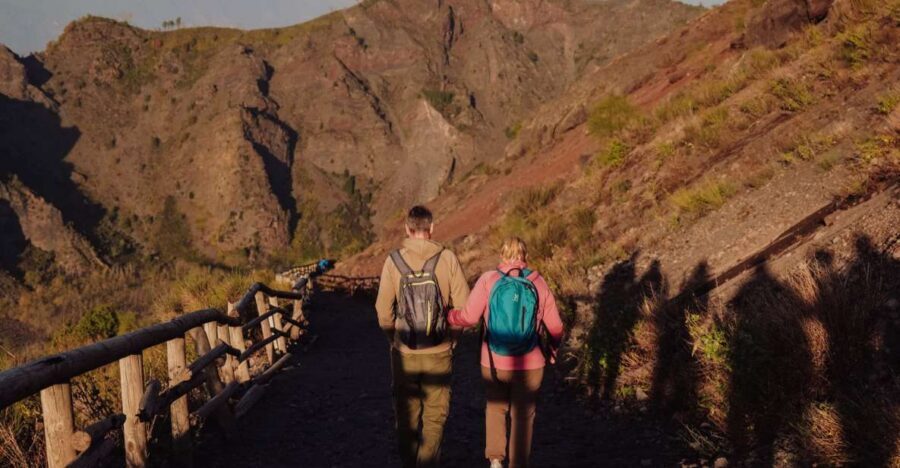
Then you move to the crater’s edge at about 1,280 meters for about 30 minutes. This is the money moment: the panorama from close to the rim is dramatic, and you get that rare feeling of being in the presence of a giant geological machine.
The path surface is uneven, so you’ll want footwear with real grip. Bring a light layer too if it’s windy. You don’t have to be an athlete, but this isn’t a flat stroll.
Timing reality: why this day feels packed
You’re looking at an 8-hour window with many Pompeii stops plus Vesuvius crater time. That structure is great if you want to maximize what you see. It can feel rushed if you want long photo breaks, bathroom stops, or deep reading.
In my book, the best mindset is to treat Pompeii like a guided “greatest hits” tour. You’ll learn the major pieces, and then (if you choose) you can return someday to slow down and linger.
One practical consideration: bathroom options around the hike to Vesuvius may be limited. I strongly suggest you use facilities before you start climbing and keep water planning simple. For comfort, also assume the day moves at a steady pace once you’re on the volcano trail.
Price and value: is $635.61 per person worth it?
At $635.61 per person, this isn’t a budget excursion. But it is built around things that are hard to replicate cheaply: private transport, a private Pompeii guide, priority access to major sites, and included admission for Pompeii and Vesuvius.
Here’s how I’d judge value:
- You’re buying time and stress reduction. Skip-the-line access matters most at Pompeii, where crowds can swallow hours.
- You’re buying context. A guide who walks you through the Forum, Baths, major houses, and civic buildings helps you understand Pompeii as a living city, not just walls and columns.
- You’re buying comfort. Hotel pickup and drop-off reduce the “how do we get there” friction.
Where the price may feel steep is if you’re traveling solo and you’d rather explore slowly without a guide. In that case, you might prefer a cheaper public option. But if you value efficiency, guidance, and a controlled itinerary, the price can make sense fast.
Also, this is often booked about 65 days in advance on average. If you want your date, don’t wait for inspiration.
Who this private tour fits best
This tour suits you if you want one day that covers Pompeii’s core sites plus a real crater-edge view at Vesuvius. It’s especially good for couples, families, and small groups who don’t want to wrestle with tickets, transport, or crowd navigation.
It may be less ideal if you want lots of unstructured time. Many stops are brief, so you’ll need to be comfortable moving through ruins with a plan.
From an age-and-comfort angle, the walking is part of the package. A group can find Pompeii a little challenging depending on mobility and comfort with walking on uneven historic ground. At Vesuvius, the path is also uneven, so plan for that.
Small, smart tips before you go
These are the practical things that tend to make the day better:
- Wear shoes with grip. Uneven paths at Vesuvius require traction more than style.
- Go easy on your schedule outside the tour. Treat this like the day that dominates your timetable.
- Plan for no included food. Food and drinks aren’t part of the package, so decide in advance how you’ll handle breaks.
- If you’re worried about time at Vesuvius, ask up front. Make sure you understand how much time you’ll have for the climb and summit edge so there are no surprises.
- Bring layers. Coastal areas and volcano summits can change quickly as you climb.
Book it or skip it? My take
If you want a private, skip-the-line day that hits Pompeii’s most important areas and still gets you to the Vesuvius crater edge, I think this is a strong choice. The guide-led Pompeii format is the main reason: it turns ruins into a city you can follow.
The trade-off is time pressure. You’ll see a lot, but you won’t live in any single spot for hours. If you’re okay with a guided plan and you’re prepared for walking plus an uneven hike, this is worth booking.
FAQ
Is hotel pickup included on the Pompeii and Vesuvius tour?
Yes. Door-to-door pickup from hotels in the Sorrento area is included, and you also get return drop-off to your hotel afterward.
How long is the tour?
The tour is approximately 8 hours.
Is this a private tour?
Yes. It’s private, and only your group participates.
Do I get skip-the-line or priority access?
Yes. You get priority access to the Pompeii Archaeological Site and priority access to Mount Vesuvius.
Are tickets included?
Yes. Admission tickets are included for Pompeii stops and Mt. Vesuvius entrance ticket is included.
Will I have an English-speaking driver and guide?
English is offered. The driver will speak English or Italian, and the Pompeii tour operates in the language you select.
What’s included and what’s not?
Included: private transportation with an English-speaking driver, a private guide for Pompeii, priority access to both sites, and the entrance ticket(s). Not included: food and drinks.
Where do I start the tour?
The start point is Piazza Torquato Tasso, 16, 80067 Sorrento NA, Italy. If you opt for hotel pickup, you’ll be collected from your hotel in the Sorrento area.
Should I reconfirm my pickup time?
Yes. You’re advised to reconfirm your pick-up time and location with the local supplier at least 48 hours prior to the tour.
What is the cancellation policy?
Free cancellation is available up to 24 hours in advance for a full refund.