REVIEW · POMPEII
Pompeii and Herculaneum small group tour – skip the line
Book on Viator →Operated by PompeiIn · Bookable on Viator
Two Roman cities in one guided sweep. I like the skip-the-line setup in Pompeii and the way the small group format keeps questions practical. You’ll still cover a lot of uneven ground and move through each area quickly, so it’s not a slow, sit-and-stare kind of day.
This is the kind of tour that helps you read what you’re seeing. With guides such as Sergio (an archaeologist), plus top-rated guides like Vince, Paulo, Diego, Michele, and Alfredo, you get explanations that make daily life in the Roman world feel real.
One thing to note: Herculaneum entry is not listed as included for the ruins stop, even though skip-the-line access is arranged, so plan to budget for that part if you’re calculating your total spend.
In This Review
- Key things to know before you go
- Skip-The-Line Entry: Starting at Porta Marina Superiore
- Pompeii in 5 Acts: Forum, Baths, Mansions and Theaters
- Basilica and the Pompeii “workday”
- Foro di Pompeya: the main square
- Casa del Menandro: the “rich house” feel
- Granai del Foro: unusual objects, plus the casts
- Terme del Foro and the Brothel lane area
- Casa del Fauno, Teatro Piccolo, and Teatro Grande
- The Train Link to Herculaneum and That Lunch Break
- Herculaneum Highlights: Domus, Central Thermae, and Charred Wood
- Casa del Rilievo di Telefo and the “private access” detail
- Wooden partitions and a house named for remains
- Central Thermae: men and women, separate entrances
- Casa del Salone Nero: carbonized door remains
- Casa Sannitica and Casa del Bel Cortile: different styles of homes
- House of the Grand Portal: collonnati and charred wood
- Guides and Small-Group Pace: Sergio, Vince, Paulo
- Price and Value at $119.85, Plus What You Still Need to Pay
- What to Bring for the Uneven Stone (Water and Shoes)
- Should You Book This One-Day Pompeii + Herculaneum Tour?
- FAQ
- Where do we meet, and where does the tour end?
- How long is the Pompeii and Herculaneum tour?
- Is the tour offered in English?
- Is the Herculaneum admission ticket included?
- Is this tour stroller-friendly or easy for limited mobility?
- Can I cancel for a full refund?
Key things to know before you go
- Skip-the-line in Pompeii helps you start seeing the ruins faster.
- One-way train transfer via Circumvesuviana is included, saving you time and stress.
- Maximum group size of 20 means you’re not just a faceless ticket scan.
- Two UNESCO sites in one day shows you two different “views” of the same eruption.
- Lots of house-and-bath stops makes it ideal if you like architecture and everyday details.
- Uneven walking and limited stroller usefulness means you should pack accordingly.
Skip-The-Line Entry: Starting at Porta Marina Superiore
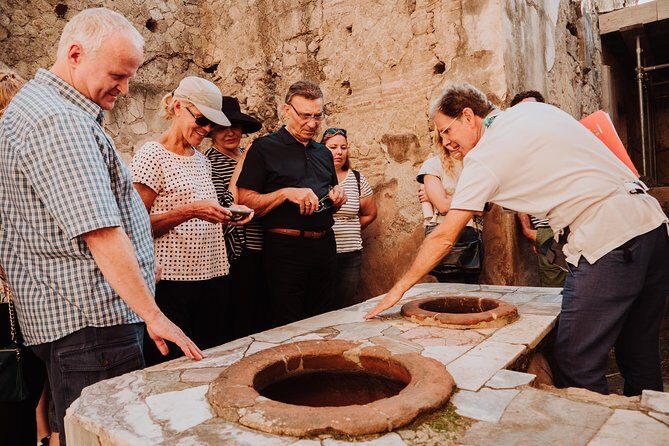
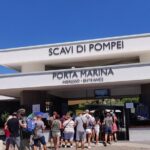
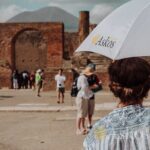
Your day starts in Pompeii at Piazza Esedra, 4. From there, you meet your guide at the archaeological park’s main entrance called Porta Marina Superiore. The guide will be holding a sign for Askos Tours, which is a small thing, but it helps you get oriented fast when you’re dealing with crowds and signage.
The big payoff here is the skip-the-line arrangement in Pompeii. Pompeii can be a ticketing bottleneck, and once you’re on the ground, you’ll realize time matters. With a guided plan and pre-arranged entry, you spend more time looking at murals, stone steps, and street layouts—and less time stuck waiting at a gate.
Also, this is a mobile ticket tour and it runs in English, with a small-group size capped at 20 travelers. That matters because Pompeii and Herculaneum are not museum shows where everything is laid out for you. Your guide’s job is to point out what the average visitor might miss: how merchants moved through covered areas, where people met in public squares, and what the houses reveal about wealth and taste.
If you like structure, this tour is built for you. If you want to wander alone with no schedule, you might find it a bit “guided,” since most stops are short and purposeful.
Other Herculaneum guided tours and tickets we've reviewed at Vesuvius & the Bay of Naples
Pompeii in 5 Acts: Forum, Baths, Mansions and Theaters
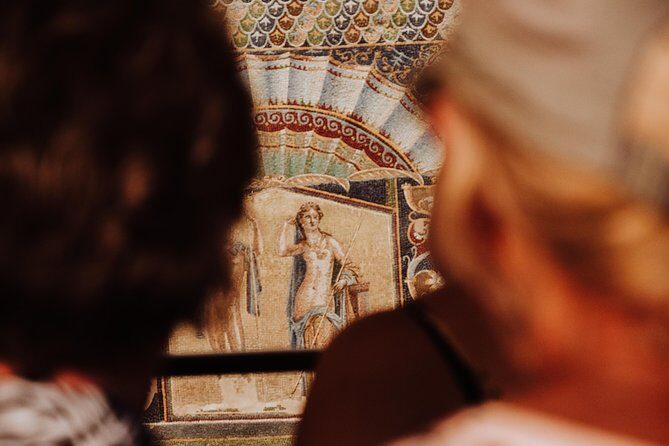
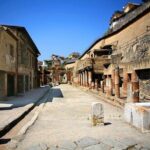
Think of Pompeii here as a guided tour through daily life. You bounce between public spaces (square, portico, baths, theater) and private spaces (wealthy houses with famous names). The pacing is tight—many stops are around 10 minutes, with a longer 15-minute theater visit—but that’s the trade-off for fitting both Pompeii and Herculaneum into one day.
Basilica and the Pompeii “workday”
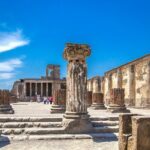
You begin with the Basilica, described as an open portico that sheltered merchants and other activities. This is a good warm-up stop because it explains how Romans turned architecture into a functional marketplace. Even without getting technical, your guide’s context helps you picture commerce happening under stone and shade, not just ancient ruins sitting in the sun.
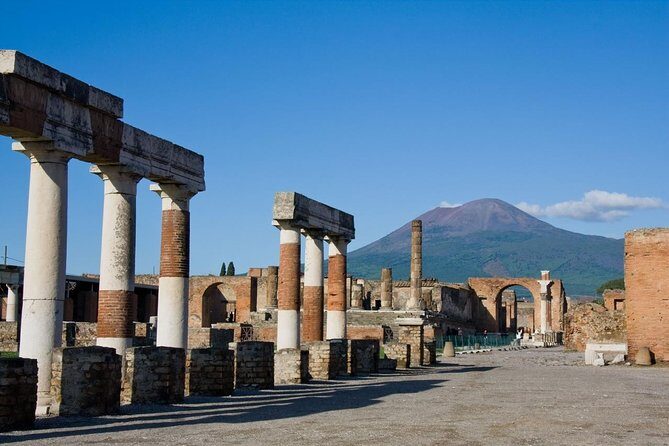
Foro di Pompeya: the main square
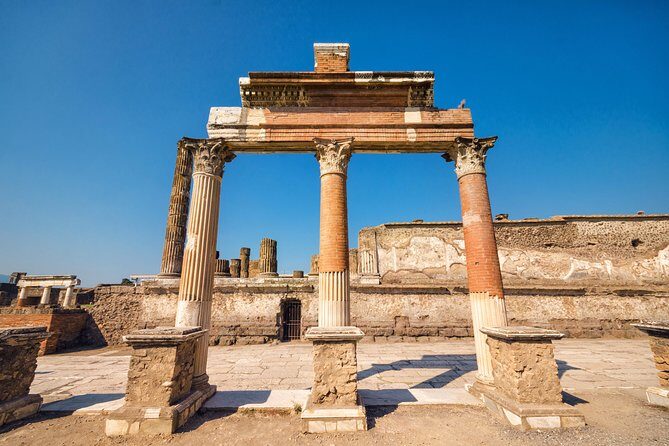
Next is the Foro de Pompeya, Pompeii’s ancient main square. In a short time window, you’re not trying to memorize every stone. You’re getting the big idea: this is where civic life and social life overlapped. Even if you only stay for a few minutes, the square becomes your reference point for everything else.
Casa del Menandro: the “rich house” feel
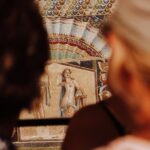
Then you move into Casa del Menandro. This is one of Pompeii’s richest houses, especially in terms of architecture, decoration, and contents. The value of a stop here isn’t just seeing a fancy room. It’s learning how decoration and layout signaled status—and how residents lived with art on walls and design choices tied to identity.
Other small group tours we've reviewed at Vesuvius & the Bay of Naples
Granai del Foro: unusual objects, plus the casts
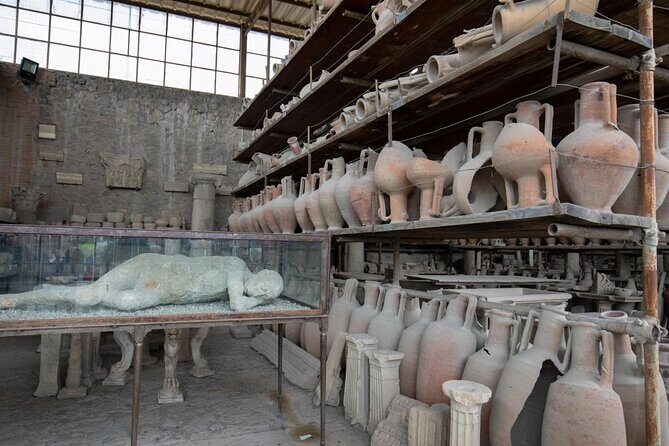
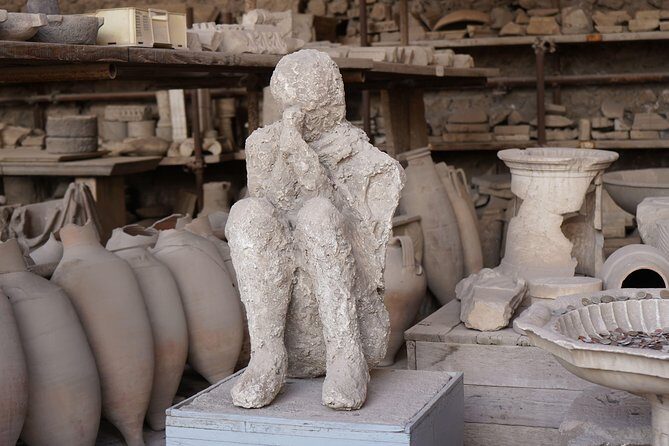
At Granai del Foro, you’ll see marble tables and baths for fountains. This stop also includes the striking part: casts of victims from the eruption, and even casts of a dog and a tree. If you’re sensitive, know this is heavy subject matter. But it’s also the clearest way to understand the scale of the disaster without turning it into pure spectacle.
One practical angle: because this stop includes more “special exhibits” content, it helps to pay attention to what your guide says rather than just doing quick photos. In a short window, your guide’s framing is what makes it land.
Terme del Foro and the Brothel lane area
Terme del Foro is next, covering a large area and described as the oldest thermal complex in the city. Your route places it between the Brothel lane, the Holconius crossroads, and the Via Stabiana, so your guide can connect the baths to surrounding streets and entertainment zones.
Right after that, you get the chance to see the most famous brothel in Roman Pompeii. It’s a reminder that entertainment and commerce weren’t separated the way we often expect today. Just be ready for the fact that these are brief looks—10 minutes goes quickly when you’re trying to take in the street context.
Casa del Fauno, Teatro Piccolo, and Teatro Grande
You end the Pompeii side with several high-name stops:
- Casa del Fauno, one of the largest and most impressive residences in Pompeii
- Teatro Piccolo, the small theater
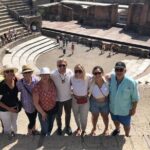
- Teatro Grande, the most important theater in Pompeii (this one gets about 15 minutes)
These stops work well together because they show how the Romans mixed private luxury with public performance. If you’re a “theater person,” the Grande visit is where it comes together: you see the scale and the civic importance, and you start connecting architecture to culture.
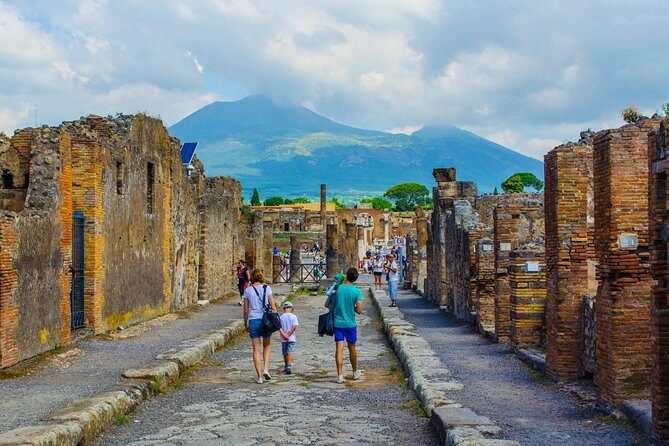
And between those stops, you’ll also walk through Pompeii’s main street, which helps tie it all together.
The Train Link to Herculaneum and That Lunch Break
Once Pompeii is done, you transfer to Herculaneum by train. Your one-way Circumvesuviana tickets from Pompeii to Herculaneum are included, which is a real value. It reduces decision fatigue and keeps the day moving.
The timing is set: the train ride is about 30 minutes, plus roughly 10 minutes of walking to reach the ruins meeting point area. The meeting place in Herculaneum is the ticket office of the Herculaneum ruins.
There’s also time built in for a quick lunch break if required. Meals are not included, so think of this as an opportunity to grab something on your own rather than a catered meal. One review noted an air-conditioned mall-style stop for lunch, which is exactly the kind of relief you appreciate in warmer months.
A real-world tip: the train station area is described as about a 10-minute walk uphill from where the ruins exit. The station has been under renovation (noted around September 2025), so follow posted signs and don’t assume you’ll find the same easy route day after day. If you’re traveling during disruption periods, allow extra buffer for getting back from the station to your next stop.
Herculaneum Highlights: Domus, Central Thermae, and Charred Wood
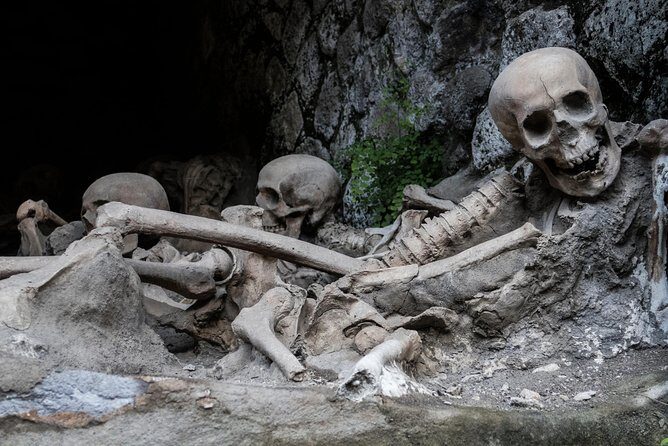
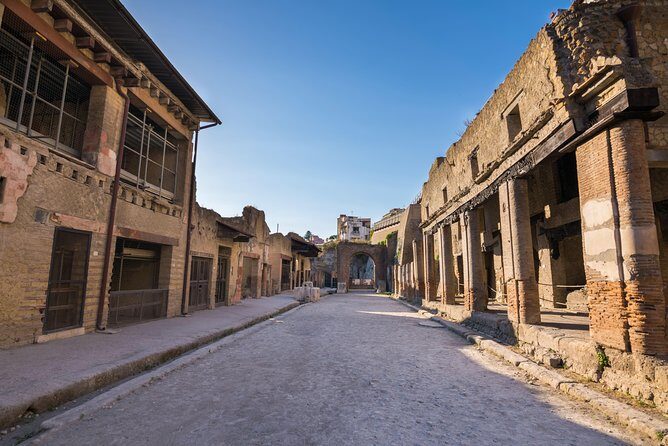
Herculaneum feels different from Pompeii—less “open city” and more compact, with preserved spaces that can feel intimate. The tour keeps it efficient: you’ll move through multiple named stops, most about 10 minutes each, so you get a snapshot of the city’s most important corners.
You start with Casa dei Cervi, named for marble stags/deer found in the peristyle. That naming system matters. Your guide’s explanations help you read why these peristyle gardens and statuary are so significant: they’re identity markers for wealth and taste.
Then you visit La Terrazza di M. Nonio Balbo. The name points toward Marcus Nonius Balbo, and you’re told the house name is tied to marble stags/deer in the peristyle. Again, the short stop is about connecting a named object to a larger picture of elite interiors.
Next is College of the Augustales. The stop is brief, but it helps you remember Herculaneum isn’t only wealthy private homes. It includes institutions and community spaces, even when you only get a short look.
Casa del Rilievo di Telefo and the “private access” detail
At Casa del Rilievo di Telefo, you get an unusual structural feature: the house possibly belonged to a leading benefactor (Marcus Nonius Balbus is mentioned), and it had its own private access to the adjoining Suburban Thermae to the south. That’s the kind of detail that makes the houses feel engineered for lifestyle, not just decorated for show.
Wooden partitions and a house named for remains
Partem Domus lignea – Casa del Tramezzo di Legno is important because an elegant wooden partition remained. And House of the Skeleton is named for human remains discovered in a second-floor room in 1831. The tour doesn’t waste time here; your guide’s context is what turns a name into meaning.
Central Thermae: men and women, separate entrances
At Central Thermae, you’ll learn it was built around the beginning of the 1st century AD and divided into men’s and women’s baths with separate entrances. This is a key “daily life” lesson. Baths weren’t just for hygiene; they were social and routine. Seeing the division helps you picture how Roman life worked through built-in rules.
Casa del Salone Nero: carbonized door remains
Casa del Salone Nero, the House of the Black Hall, stands out for the monumental entrance and the carbonised remains of doorposts and lintel. That’s one of those details that makes the past feel alarmingly physical, not just “a story from a book.”
Casa Sannitica and Casa del Bel Cortile: different styles of homes
In Casa Sannitica, you’re told it’s typical of the Samnites. The atrium is described as splendid and skirted by a gallery with Ionic columns, with rooms decorated in frescoes. Even in a 10-minute window, the architecture and fresco mention gives you a quick style contrast.
In Casa del Bel Cortile, you see an original layout: a courtyard with a stairway and a stone balcony instead of an atrium. That’s a great reminder that “Roman house” isn’t one single template.
House of the Grand Portal: collonnati and charred wood
Finally, House of the Grand Portal is described as a beautiful domus with various environments, collonnati, frescoes, and charred remains of wooden parts. It’s a fitting finale because it reinforces what makes Herculaneum so visually striking: the way materials survived, including burned wood elements.
Guides and Small-Group Pace: Sergio, Vince, Paulo
The real engine of this tour is how your guide reads the site and manages time. The best reviews praise guides like Sergio, described as an archaeologist, plus Vince and Vincenzo for humor and professionalism, and Paulo for his wealth of knowledge. Other praised guides include Diego, Michele, and Alfredo.
What I like about this setup for your experience is not just the facts. It’s the pacing. A group of up to 20 means you can ask questions and get answers that aren’t rushed. You’re also more likely to notice details your guide points out—like where certain ruins fit into street life, or what specific rooms tell you about status.
That said, this is still a lot of walking. One helpful review put it plainly: it is not stroller friendly, with uneven walking in the ruins. If you’re traveling with small kids, plan to carry the baby rather than relying on a stroller. Even if you bring one, the practicality will quickly become a pain point.
Bring water, use the restroom before you start, and wear shoes you trust on stone. Pompeii and Herculaneum can be slippery or uneven, and shortcuts do not exist when you’re inside the archaeological paths.
Price and Value at $119.85, Plus What You Still Need to Pay
At $119.85 per person, this tour is priced like a “value-for-time” day. You’re not just buying a guide. You’re also getting a guided experience for the entire duration, skip-the-line arrangements, and the Circumvesuviana train tickets one-way from Pompeii to Herculaneum.
For Pompeii, the itinerary indicates admission tickets for the stops are included. That’s important: entry fees can add up fast when you’re doing multiple sites. In Herculaneum, the ruins admission ticket is listed as not included for the Herculaneum stop, even though skip-the-line tickets are mentioned in the included features. In plain terms: you should expect to pay for Herculaneum entry separately while still benefiting from a smoother start.
Also, meals are not included. You’ll have a quick lunch break opportunity if you need it, but you’ll be paying for food yourself.
So is it worth it? If your priority is seeing both UNESCO sites in one day with reduced ticketing friction, the included train and skip-the-line setup make the price feel reasonable. If you’d rather spend longer inside each site or want minimal walking, you might get better value by doing them separately.
What to Bring for the Uneven Stone (Water and Shoes)
This is a practical, no-nonsense ruins day. Here’s what matters most:
- Water: one review explicitly recommended bringing water and drinking it all up, with advice to fill a bottle at a Roman water spring.
- Toilet timing: use the toilet before the tour starts. Once you’re walking through ruins, options get limited.
- Shoes: expect uneven surfaces. Ruins are not level floors.
- No stroller reliance: this is a walking-focused tour with uneven ground. Plan to carry if needed.
- Watch the station walk: in Herculaneum, the station is described as a walk uphill from the ruins exit. Give yourself time.
Weather also affects comfort. One review mentioned rain, and the guide was thoughtful about keeping everyone comfortable. But hot sun is another story, and Pompeii/Herculaneum are open-air ruins where you’ll feel it.
If you’re the kind of person who likes to take your time reading inscriptions, know you’ll be moving quickly. That’s not a flaw—it’s the method for doing both cities in one day.
Should You Book This One-Day Pompeii + Herculaneum Tour?
Book it if you want a guided, small-group way to hit the highlights of both Pompeii and Herculaneum without spending your day stuck in lines. The skip-the-line setup in Pompeii, plus the included Circumvesuviana transfer, is a strong combo for squeezing in two UNESCO sites when your schedule is tight.
I’d lean toward booking if you enjoy:
- architecture and room layouts in a short time window
- daily-life context (forums, baths, theaters, houses)
- a guide you can actually ask questions to in a group up to 20
Skip it (or adjust expectations) if:
- you need stroller access or easy mobility surfaces
- you want long, slow time in one place rather than fast highlights across many stops
- you prefer meals included or don’t want to budget for Herculaneum admission separately
If you do book, do the boring prep: good shoes, water, and a realistic plan for walking. Then let the guide do the heavy lifting of interpretation. That’s where this day pays off.
FAQ
Where do we meet, and where does the tour end?
You start at Piazza Esedra, 4, 80045 Pompei NA, Italy. The tour ends at the Archaeological Park of Herculaneum, Corso Resina, 187, 80056 Ercolano NA, Italy, with the meeting point inside Herculaneum at the ticket office.
How long is the Pompeii and Herculaneum tour?
The duration is about 5 hours 30 minutes.
Is the tour offered in English?
Yes, it’s offered in English.
Is the Herculaneum admission ticket included?
The ruins stop in Herculaneum lists admission tickets as not included, even though skip-the-line access is arranged. You should plan for Herculaneum entry costs separately.
Is this tour stroller-friendly or easy for limited mobility?
It involves lots of walking on uneven ground, and it is not stroller friendly. If you need mobility-friendly routes, this tour may be challenging.
Can I cancel for a full refund?
Yes. You can cancel up to 24 hours in advance for a full refund.