REVIEW · NAPLES
Pompeii and Herculaneum led by an Archaeologist with private transport
Book on Viator →Operated by Askos Tours · Bookable on Viator
Two doomed cities, one tight schedule. This private Pompeii and Herculaneum day pairs an archaeologist guide with air-conditioned Mercedes-style transport, so you spend less time figuring things out and more time seeing the big evidence of Roman life. I like how the tour stops at standouts like the House of the Deer and the Central Thermae, and I also like the door-to-door pickup around Naples, Salerno, Sorrento, and the Amalfi Coast. The only real drawback is that it’s a packed day, so each area is visited for a limited amount of time.
What makes it work is the people. Guides such as Lucio, Alfredo, Daniela, Mena, Ivan, and Benedetto are repeatedly praised for staying clear, answering questions, and explaining what you’re looking at while you’re standing in the room—charred wood, ash layers, and all. You’ll also hit Pompeii’s famous anchors like the Lupanar brothel and the Teatro Grande without feeling like you’re wandering blind.
You should go into it with the right expectations. You’re walking a lot over ancient, uneven ground in about 7 hours, so wear comfortable shoes and plan for strong sun (especially in summer).
In This Review
- Key highlights to look for on this day
- Door-to-door Campania pickup and A/C transport between the parks
- Herculaneum’s domus route: House of the Deer to the Grand Portal
- Kickoff at the Herculaneum ruins
- House of the Deer (Casa con i cervi)
- Terrazza di M. Nonio Balbo
- College of the Augustales
- Central Thermae
- Casa del Rilievo di Telefo
- House of the Skeleton
- House of the Black Salon
- Wooden partition rooms: Tramezzo di Legno
- Casa Sannitica and its frescoed rooms
- Casa del Bel Cortile
- House of the Grand Portal
- What to know about timing here
- Pompeii’s main hits after lunch: Lupanar, Forum, baths, and theaters
- Lupanar: Pompeii’s famous brothel
- Foro de Pompeya (Forum)
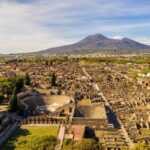
- Walk through Pompeii’s main street
- Granaries of the Forum
- Basilica and the portico for commerce
- Stabian Baths (Terme Stabiane)
- House of Menander and House of the Faun
- Teatro Grande and a quick peek at Teatro Piccolo
- Why the archaeologist guide changes what you notice
- Price and value: what $666.75 per person buys you
- Quick tips to make this long walking day easier
- Should you book this Pompeii and Herculaneum archaeologist day trip?
- FAQ
- How long is the Pompeii and Herculaneum tour?
- Where can I be picked up?
- What language is the tour in?
- Are the entrance tickets included?
- Is lunch included?
- Is this a private tour?
- What cancellation window do I get?
Key highlights to look for on this day
- Private archaeologist-led pace that helps you notice details fast
- A/C Mercedes-style transport between Herculaneum and Pompeii
- Herculaneum’s luxury houses and baths in a single flowing route
- Pompeii’s most talked-about areas like the Forum and the Lupanar
- Lunch break flexibility (take it or keep moving for fewer crowds)
Door-to-door Campania pickup and A/C transport between the parks
This tour is built for convenience. You can be picked up from your accommodation, or from practical hubs like a cruise port, train station, or airport, with service across Naples, Salerno, Sorrento, and the Amalfi Coast. That matters because getting to Pompeii and Herculaneum on your own can turn into a day of trains, buses, and timing headaches.
The transfer itself is private and air-conditioned, handled by a professional driver in a Mercedes-style vehicle. In practice, that means you get a comfortable buffer between sites—no squished seats, no waiting while other groups trickle in. It also helps the tour stay on track, which is important because you’re squeezing both parks into one day.
At Herculaneum, you meet your guide at the ticket office for the ruins. After Pompeii, you’re dropped back at your accommodation in the same Campania coverage area. This is the kind of structure that’s perfect if you’re short on time, like when you’re visiting on a cruise or you want one “big day” instead of two separate trips.
If you're still narrowing it down, here are other tours in Naples we've reviewed.

Herculaneum’s domus route: House of the Deer to the Grand Portal
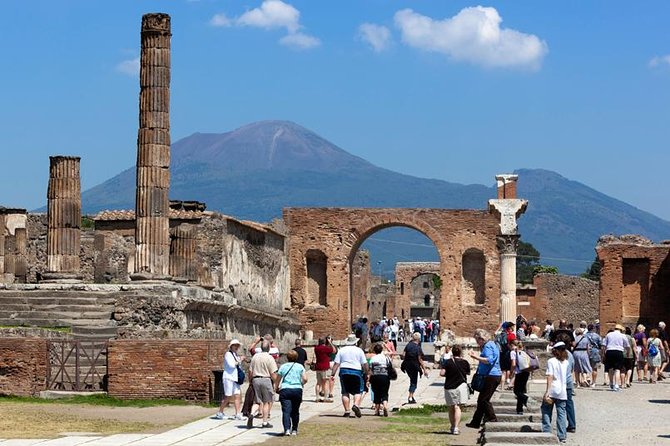
You start at Herculaneum, and you’ll get the advantage of doing it first. Herculaneum is smaller than Pompeii, and it often feels less chaotic, so it’s a smart choice for a first half of the day when you’re still fresh.
Kickoff at the Herculaneum ruins
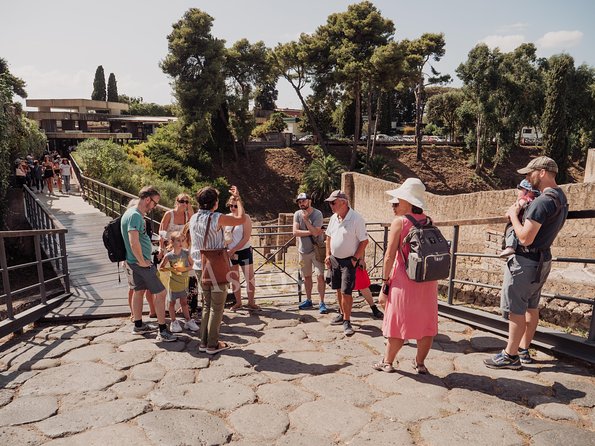
Your archaeologist guide meets you at the ticket office, then you step into the archaeological park. This first stretch sets the tone: you’re not just seeing ruins, you’re learning what the spaces were for—houses, baths, and social buildings tied together by everyday routines.
House of the Deer (Casa con i cervi)
One of the first notable stops is the House of the Deer, named for marble stag/deer figures found in the peristyle area. Even with a short visit, you’ll see why Herculaneum feels more “human-scale” than big public ruins: you’re in the rooms and circulation spaces where people lived.
Terrazza di M. Nonio Balbo
Next up is the Terrazza di M. Nonio Balbo, tied to the city’s major benefactor. You get a strong sense of who funded what—public building restoration and construction—and how status worked in a Roman city.



College of the Augustales
The College of the Augustales is a key cultural stop, linked to the cult of Emperor Augustus and the Collegium Augustalium. The building helps you understand religion and civic identity weren’t separate topics; they were built right into the city’s institutions.
Central Thermae
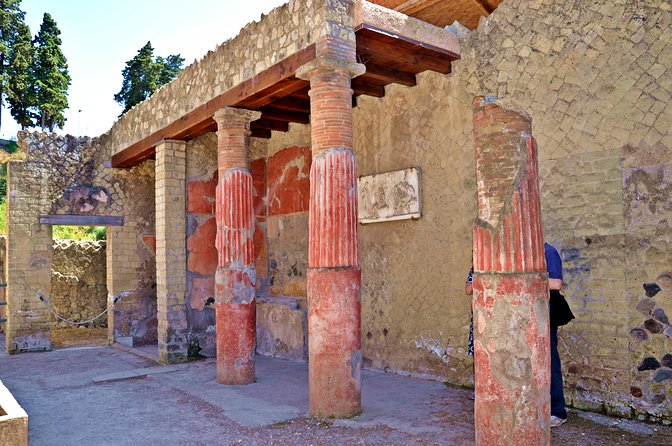
At the Central Thermae, you’re looking at an early 1st-century AD thermal complex divided into men’s and women’s baths with separate entrances. This is a great stop for realizing how “public” spaces were still structured around boundaries and daily schedules.
Casa del Rilievo di Telefo
The Casa del Rilievo di Telefo is described as likely belonging to a leading benefactor and noted for having private access to the adjoining Suburban Thermae. That tiny detail matters because it shows how luxury could be connected directly to leisure infrastructure.
House of the Skeleton
The House of the Skeleton gets its name from the discovery of human remains in a second-floor room discovered in 1831. It’s a heavy stop, but it’s also a reminder of what the site preserves, down to the conditions of real people.
House of the Black Salon
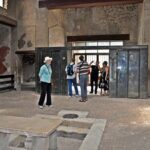
The House of the Black Salon is one of Herculaneum’s more luxurious mansions. The monumental entrance preserves carbonised remains of doorposts and lintel, which turns a “dark ruin” into a vivid moment of evidence you can actually point at.
Wooden partition rooms: Tramezzo di Legno
Partem Domus lignea, also connected to the Casa del Tramezzo di Legno, spotlights an elegant wooden partition that has survived in the archaeological story. If you care about craft and how rooms were divided, this is the kind of detail your guide is likely to explain clearly.
Casa Sannitica and its frescoed rooms
Casa Sannitica shows an arrangement typical of the Samnites, with a splendid atrium and a gallery with Ionic columns. The rooms are decorated with frescoes, so you get a glimpse of how painted walls shaped the feel of daily life.
Casa del Bel Cortile
Casa del Bel Cortile is original in layout: a courtyard with a stairway and a stone balcony, replacing an atrium. It’s a good reminder that even within Roman house styles, local variations existed.
House of the Grand Portal
The Grand Portal domus sits in the centre of the archaeological area, with collonnati and frescoes. You’ll also see charred remains of wooden parts, which your guide can connect to how the eruption affected materials differently across the two sites.
What to know about timing here
Many Herculaneum stops are brief (often around 10 to 15 minutes). That’s not a flaw—it’s the format. With an archaeologist guiding you, each stop is a “highlight hit,” and you’re less likely to miss key things like bath layout, building function, or who funded what.
Pompeii’s main hits after lunch: Lupanar, Forum, baths, and theaters
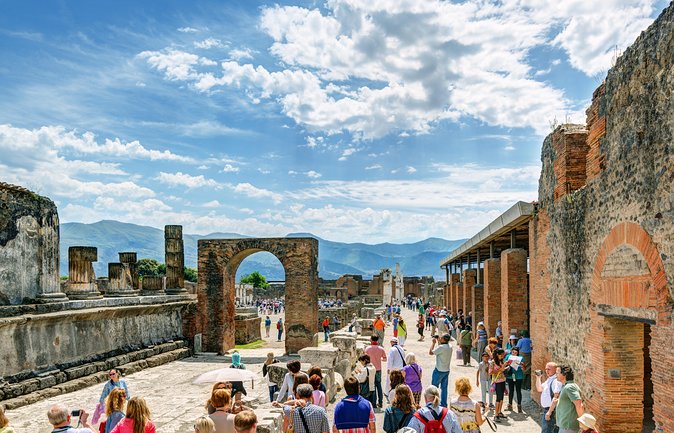
After Herculaneum, you’ll continue into Pompeii. There’s free time to have lunch on your own, with about 30 minutes set aside for that pause.
This matters because Pompeii can feel busy. If you’d rather keep your day moving and maximize your site time, the lunch window is flexible in spirit even if you still have that scheduled block—you can choose a quick bite and get back into the ruins.
Lupanar: Pompeii’s famous brothel
The Lupanar is the most famous brothel in Pompeii. It’s a quick stop, but it’s also one of the best places to understand Pompeii wasn’t just temples and big villas—it held everyday life, including the things people whispered about and wrote into the margins.
Foro de Pompeya (Forum)
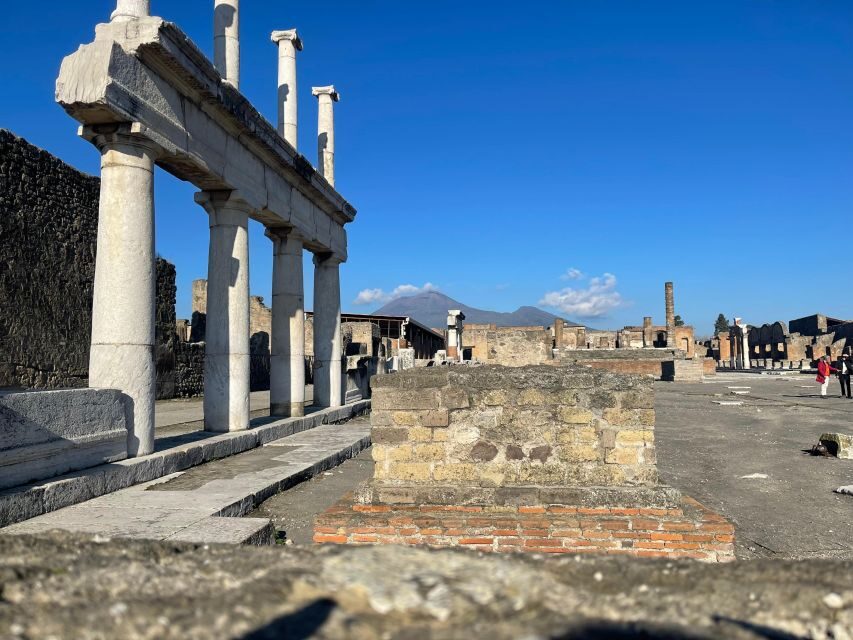
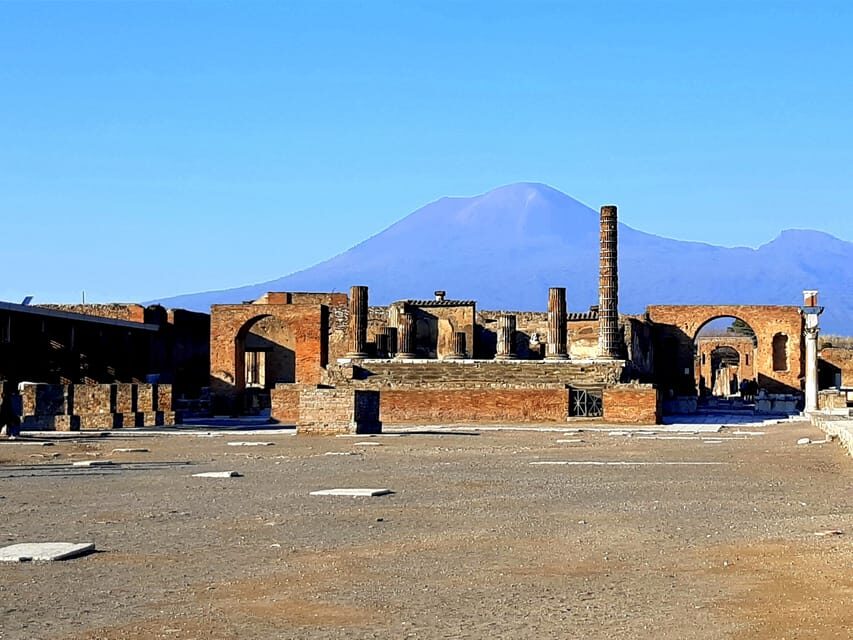
Then you step into the ancient main square, the Foro de Pompeya. This is where the city’s “center” energy shows up: circulation, civic identity, and the way public space worked as a meeting point.
Walk through Pompeii’s main street
A walk through the main street gives you scale. It helps you connect the big landmarks so the layout starts to click, instead of feeling like a pile of separate ruins.
Granaries of the Forum
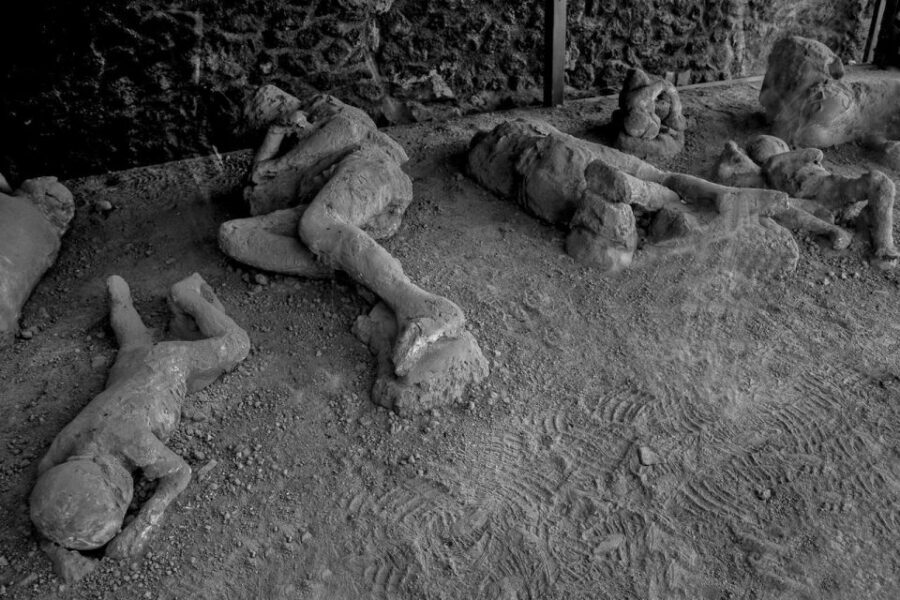
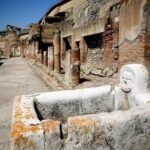
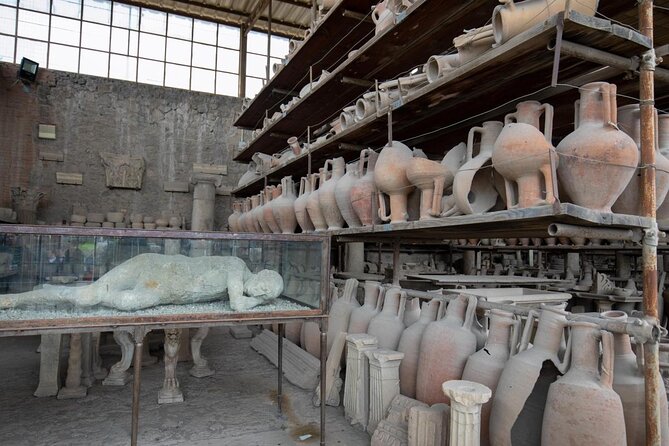
In the granaries, you’ll see marble tables and baths for fountains at house entrances, plus casts of victims of the eruption and even those of a dog and a tree. This stop is often startling because it shifts the story from architecture to human impact in a direct, visible way.
Basilica and the portico for commerce
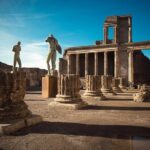
The Basilica was an open portico sheltering merchants and other activities. It’s a great mental reset after the heavier granary stop, because it pulls you back to how commerce and services moved through public space.
Stabian Baths (Terme Stabiane)
Next comes the Stabian Baths, one of the oldest thermal complexes in the city. The baths cover a large area, and your guide can help you visualize how people used thermal spaces as social hubs, not just for hygiene.
House of Menander and House of the Faun
The House of Menander is one of Pompeii’s richest houses in architecture, decoration, and contents. Then the House of the Faun gives you one of the largest and most impressive private residences. If you’re thinking about art, property, and status, these are the best contrast points after the Forum and baths.
Teatro Grande and a quick peek at Teatro Piccolo
Finally, you’ll visit Teatro Grande, the most important theater in Pompeii, and you’ll also look at the smaller Teatro Piccolo. Even if you only have short time at each, theaters help you understand leisure and public gatherings—why cities built spaces to perform culture, not only to enforce power.
Why the archaeologist guide changes what you notice
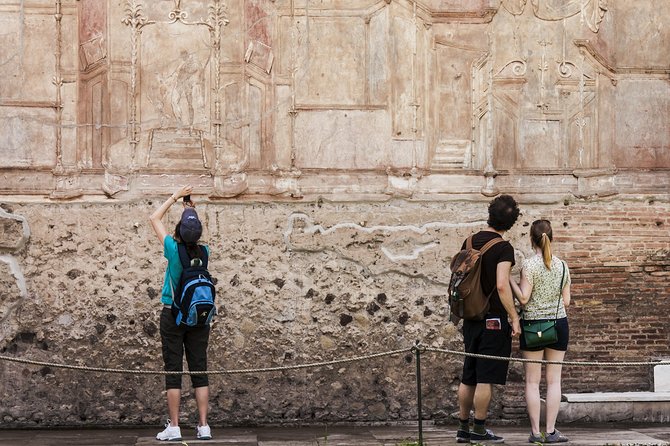
This tour’s biggest strength is the interpretive layer. You’re not only walking through ruins; you’re learning what to look for and how to connect the dots between neighborhoods.
A recurring theme from guide feedback is that they explain the two eruptions in clear, memorable terms. One guide example highlights how Pompeii was buried under a rain of roughly 300-degree ash, while Herculaneum was leveled by landslides involving about 600-degree volcanic molten rock. When you hear that, charred wood remains and preserved surfaces start to make more sense.
Field experience also shows up in the way guides answer questions on the spot. In real-world examples, people describe guides like Ivan and Benedetto as able to explain engineering and the culture with confidence, plus respond patiently when someone has mobility limits. If that might apply to your group, tell the provider in advance so your guide can set a slower, steadier pace.
Guides also help you avoid the common “I saw it but didn’t really get it” feeling. With so many named stops, the difference is whether you understand why each house, bath, or public building matters. An archaeologist guide turns a 10-minute pause into something you remember.
Price and value: what $666.75 per person buys you
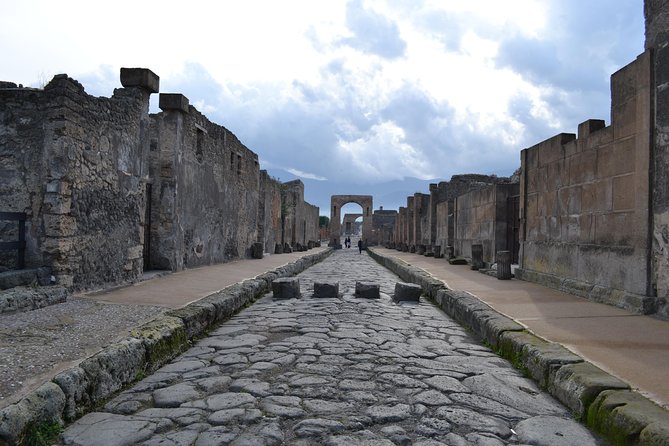
At $666.75 per person for a ~7-hour private experience, you’re paying for three things: transport that saves time, guided interpretation, and admissions handling so you’re not doing a scavenger hunt.
You get hotel or port pickup and drop-off, private minivan transport with a professional driver, and guidance for the entire day. You also get admission ticket coverage via a Pompeii Express ticket approach, and entrance fees for Herculaneum and Pompeii are listed as included. Meals aren’t included, and you’ll have the option for lunch during the Pompeii portion.
So when is the price worth it? It tends to make the most sense if you want both parks in one go and you’d rather pay to reduce stress than to spend your day trying to coordinate everything yourself. It’s also a strong value if your group wants to ask questions, move at a comfortable pace, or prioritize highlights over wandering.
If you’re traveling solo or as a couple who enjoys self-guided museums, you might prefer a cheaper option. But if you want a guided day that helps you read what you’re seeing—especially across both Herculaneum and Pompeii—this is the kind of package that turns ruins into a story.
Quick tips to make this long walking day easier
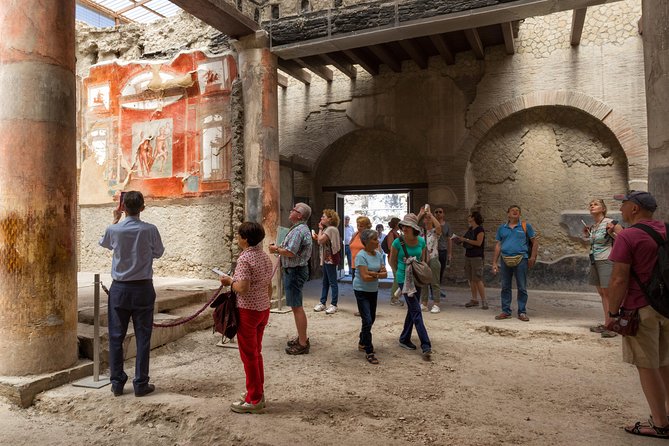
- Wear comfortable shoes with grip; the ground is ancient and uneven.
- Bring sunglasses, sunscreen, and water because you’ll be out in the open.
- In summer, skip flip-flops. It’s not just about comfort; it’s about safety.
- If you’re trying to reduce crowds, keep lunch quick and don’t treat every stop as optional. The day runs on momentum.
- Pack a small snack or two if you can; walking time is significant and it helps morale between stops.
Should you book this Pompeii and Herculaneum archaeologist day trip?
Book it if you want a smart, guided way to see both Pompeii and Herculaneum in one day, without losing hours to logistics. It’s especially good for first-timers who want the major highlights and also care about understanding daily life—houses, baths, public spaces, and the eruption’s impact.
Skip it (or consider a slower plan) if you hate tight schedules. Many stops are short, and you don’t get the kind of slow, reflective time you might want for deeper self-guided exploration.
If your priority is comfort, door-to-door pickup, and an archaeologist who can explain what you’re looking at while you’re right there, this private tour is a strong choice.
FAQ
How long is the Pompeii and Herculaneum tour?
It’s about 7 hours (approx.) total.
Where can I be picked up?
Pickup is offered from Naples, Salerno, Sorrento, and the Amalfi Coast, and you may also be picked up from the cruise port, train station, or airport.
What language is the tour in?
The tour is offered in English.
Are the entrance tickets included?
The tour includes the Herculaneum entry tickets and Pompeii Express entry tickets. Herculaneum entry is listed as 16 euros for adults, and 2 euros for EU citizens ages 18–25.
Is lunch included?
Meals are not included. There is free time to have lunch on your own during the Pompeii portion of the day.
Is this a private tour?
Yes. Only your group will participate.
What cancellation window do I get?
Free cancellation is available up to 24 hours in advance for a full refund.