REVIEW · POSITANO
Transfer from Naples to Positano with 2 hours Private Tour in Herculaneum
Book on Viator →Operated by Askos Tours · Bookable on Viator
Two towns, one smooth plan. This private Naples-to-Positano ride pairs an air-conditioned van with a guided Herculaneum stop, so you trade long transit waits for Roman streets you can actually fit in. I love the door-to-door pickup where you want it in Naples, and I love that your driver stays with the vehicle and your bags while you tour.
The only real catch is time discipline. The Herculaneum visit is arranged in short, focused stops, and there are no meals built in—so plan on a quick snack strategy before you go.
In This Review
- Key Points to Know Before You Go
- A Private Naples to Positano Transfer That Actually Saves Your Day
- Why Herculaneum Works So Well as Your “In-Between” Stop
- Your Guided Herculaneum Walk: The Stop Plan (And What Each One Adds)
- Parco Acheologico di Ercolano (Meet Point)
- Casa dei Cervi (The House of the Stags/Deer)
- La Terrazza di M. Nonio Balbo (A Benefactor’s Mark)
- College of the Augustales (Politics, Religion, and Power)
- Casa del Rilievo di Telefo (House With a Private Connection)
- Partem Domus lignea – Casa del Tramezzo di Legno (Saved Wood Partition)
- House of the Skeleton (Named After 1831 Remains)
- Central Thermae (Separate Baths for Men and Women)
- Casa del Salone Nero (The House of the Black Hall)
- Casa Sannitica (Samnite-Style Layout + Frescoes)
- Casa del Bel Cortile (Courtyard With a Stair and Balcony)
- House of the Grand Portal (Central Area + Frescos + Charred Wooden Parts)
- What “Private, Guided, and Air-Conditioned” Really Means in Practice
- Price and Value: Is $456.70 Per Person Reasonable?
- Who This Tour Fits Best (And Who Might Prefer Something Else)
- Practical Tips for Getting the Most From the Ruins Portion
- Should You Book This Naples-to-Positano + Herculaneum Tour?
- FAQ
- Where is the pickup located for the transfer?
- How long is the tour from Naples to Positano?
- What happens during the Herculaneum guided visit?
- Are Herculaneum entrance tickets included?
- Is the transfer one-way, and do you get dropped off in Positano?
- Are meals included?
- Are car seats available?
- Is this tour private?
- Can I cancel for a full refund?
Key Points to Know Before You Go
- Pickup exactly where you choose in Naples with a scheduled time and door-to-door ease.
- A professional Herculaneum guide at the ticket office, which helps you make sense of what you’re seeing fast.
- A guided “highlights route” with lots of short stops covering houses, thermæ, and public spaces.
- The driver stays put so you’re not juggling luggage or wasting time repositioning.
- Admission to Herculaneum is included (tickets are listed at €16 each).
- Drop-off in Positano is included, not just a random meeting point.
A Private Naples to Positano Transfer That Actually Saves Your Day
If you’re aiming to enjoy the Amalfi Coast without starting your vacation with chaos, this kind of private transfer is a strong move. Instead of timing buses or squeezing onto trains and then recalculating your schedule, you go straight from Naples to Positano in a private air-conditioned minivan with a professional driver.
What makes it feel worth it is the way it combines two tasks:
- moving you reliably to Positano
- adding a guided Roman stop at Herculaneum without you doing any extra legwork
You also get luggage handling baked into the setup. The driver stays with the vehicle, so you’re not dragging bags through ruins or trying to meet someone at the wrong corner. That may sound small, but it’s the kind of stress you don’t need after getting to Naples in the first place.
One more detail that matters: the tour is private. That means you’re not sharing the rhythm with other groups who all want different paces. Your schedule is simply yours.
Other Herculaneum guided tours and tickets we've reviewed at Vesuvius & the Bay of Naples

Why Herculaneum Works So Well as Your “In-Between” Stop

Herculaneum is often treated like the lesser-known cousin of Pompeii, and that’s exactly why it fits a transfer day so well. The ruins are extensive, but this tour is designed to show you what you’ll remember—named houses, key public spaces, and the kinds of details that make a buried ancient city feel specific rather than generic.
The experience is paced in a way that keeps momentum. You’re not spending hours wandering with no structure. Instead, you hit multiple spots across the archaeological park, with each stop timed so you can see a lot without feeling like you’re racing from place to place.
And since the guide is there for the full Herculaneum portion, you get context while you’re actually looking at the stones. That’s when the explanations stick.
Your Guided Herculaneum Walk: The Stop Plan (And What Each One Adds)
The route begins at the Parco Acheologico di Ercolano, where you meet your guide at the ticket office. From there, the plan moves through a sequence of notable buildings and features. Expect the structure to feel like a highlights tour: short visits, key visual points, and fast guidance.
Here’s what you’ll cover, in the order you’ll see it:
Parco Acheologico di Ercolano (Meet Point)
This is your entry to the archaeological area and the jump-off for the guide-led story. It’s where you get your bearings and a baseline understanding of what you’re about to see, which makes every named house and thermæ feel more meaningful later.
One practical plus: the admission is part of the package, so you’re not hunting for tickets or worrying about separate payments while others in your group figure out what to do.
Casa dei Cervi (The House of the Stags/Deer)
This stop is quick, but it has a strong “name-means-something” payoff. The house gets its name from marble statues of deer found in the peristyle. It’s a great example of how Herculaneum’s labels aren’t random—they come from specific discoveries.
If you like details that connect archaeology to real objects, this is the kind of stop that makes you think, okay, someone really studied what was here.





La Terrazza di M. Nonio Balbo (A Benefactor’s Mark)
This terrace ties the ruins to a particular person: M. Nonius Balbus, described as the city’s major benefactor. You’ll also hear about the honours and information recorded in a long inscription on the funeral altar.
This is the type of stop that helps you read the site as a lived community, not just an outdoor museum. You learn why certain structures mattered and how public memory worked in Roman life.
College of the Augustales (Politics, Religion, and Power)
You’ll visit the College of the Augustales, thought to relate to the cult of the Emperor Augustus. The building may also connect to the Collegium Augustalium—or even the local curia, depending on interpretation.
Even though your time here is short, the big win is your mental model. Instead of only seeing homes, you see where formal groups operated and how civic and imperial worship could overlap.
Casa del Rilievo di Telefo (House With a Private Connection)
The Casa del Rilievo di Telefo is notable partly because it may have belonged to a leading benefactor, and partly because it had its own private access to the adjoining Suburban Thermae to the south.
That detail matters. It reminds you that these were not generic ruins. They’re evidence of everyday convenience, status, and the way people moved through space.
Partem Domus lignea – Casa del Tramezzo di Legno (Saved Wood Partition)
One of the most interesting stops is the Partem Domus lignea, the house area tied to the elegant wooden partition that remains.
This is where Herculaneum feels different from places where you only see stone foundations. Seeing (or learning about) preserved wood elements helps you understand what “house design” really meant in Roman times, not just what structures look like today.
House of the Skeleton (Named After 1831 Remains)
The House of the Skeleton is named from the discovery of human remains in a second-floor room in 1831. It’s a darker story than some of the other stops, but it’s part of what makes the site real.
If you’re the kind of person who wants your ruin visit to be honest—people lived here, and accidents and tragedies happened—this is an important checkpoint in the route.
Central Thermae (Separate Baths for Men and Women)
The Central Thermae are built around the beginning of the 1st century AD and divided into men’s and women’s baths. Each had separate entrances, which is an easy detail to miss if you only glance.
This stop is valuable because it gives you a clear picture of daily routines and social structure. A bathhouse isn’t just a room with tubs—it’s an organized space with rules.
Casa del Salone Nero (The House of the Black Hall)
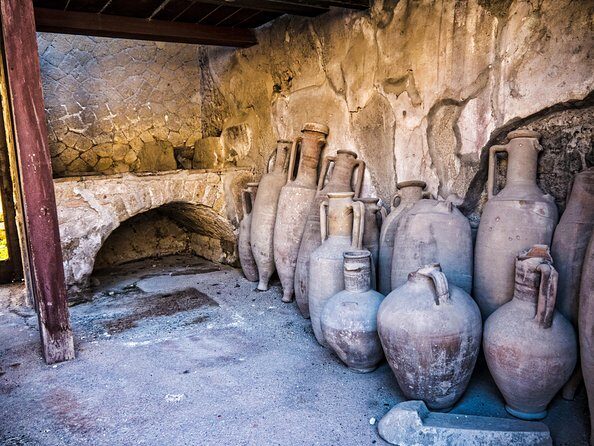
This is described as one of Herculaneum’s more luxurious mansions. The stop includes a monumental entrance that still retains carbonised remains of the doorposts and lintel.
Even on a fast route, this is the kind of place that makes you pause. It’s physical evidence of what happened and what survived—another reminder that the guide isn’t only reciting facts. You’re looking at them.
Casa Sannitica (Samnite-Style Layout + Frescoes)
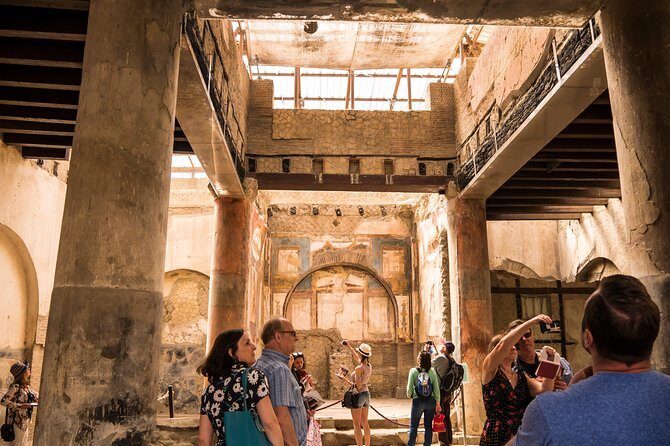
You’ll see Casa Sannitica, notable for an arrangement typical of the Samnites, including an atrium with a gallery with Ionic columns and rooms decorated with frescoes.
What I like about stops like this is how they help you connect regional culture to what you see on-site. It’s not just Roman branding—it’s a snapshot of identity and influence.
Casa del Bel Cortile (Courtyard With a Stair and Balcony)
The Casa del Bel Cortile is called out for its courtyard, stairway, and a stone balcony instead of an atrium.
This is a small structural variation, but that’s often where architecture becomes understandable. When you notice layout differences, you start to see houses as “designed,” not just “found.”
House of the Grand Portal (Central Area + Frescos + Charred Wooden Parts)
The House of the Grand Portal sits centrally in the archaeological area and is described with multiple environments, colonnati, frescoes, and even charred remains of wooden parts.
This is a fitting final highlight because it rolls together several visual categories: entrances, decoration, and the evidence of wooden elements surviving in charred form.
What “Private, Guided, and Air-Conditioned” Really Means in Practice
Let’s be honest: on paper, many transfers sound similar. The difference is how they handle friction. This one is built to remove it.
- Air-conditioned minivan helps during the ride (and you arrive in Positano ready to move on, not damp and frazzled).
- Professional driver reduces decision-making. You’re not guessing where to stand, which lane to cross, or how long the next leg will take.
- Your bags stay covered by the plan since the driver remains with the vehicle during the guided Herculaneum time.
- Hotel drop-off is included in Positano, which matters because Positano can be tricky to navigate once you’re on your own.
Also, the tour uses a mobile ticket. That’s one less thing to manage while you’re coordinating Naples departure and checking in at the right place.
Price and Value: Is $456.70 Per Person Reasonable?
At $456.70 per person, this is not a bargain-basement add-on. But it’s also not just transport. You’re buying a bundle:
- one-way private transfer from Naples to Positano
- air-conditioned vehicle with a professional driver
- a full guided visit in Herculaneum
- entry tickets included (listed as €16 each)
- assistance and taxes
- Positano drop-off
If you were to piece this together yourself, you’d likely end up paying for a private car anyway, then paying for entrance and trying to source a guide for the ruins. What you’re paying for here is certainty and time.
The best value angle is for visitors who want to do Amalfi Coast logistics without burning half the day planning routes. If that’s your goal, this tour structure supports it.
Who This Tour Fits Best (And Who Might Prefer Something Else)
This works especially well for:
- couples or small groups who want a smooth plan with minimal moving parts
- travelers who don’t want to deal with train/bus timing to reach the coast
- people who want a guided Roman stop without turning the day into a scavenger hunt
It may feel less ideal if you:
- hate time-limited museum stops
- want a long, slow wander with lots of unstructured freedom
- plan on eating at leisure during the route, because meals aren’t included and the schedule is tight
If you fall into the second category, consider a longer, multi-stop ruins visit in the future. This one is built to be efficient.
Practical Tips for Getting the Most From the Ruins Portion
Since your time at Herculaneum is split into short visits, small preparation helps a lot:
- wear comfortable shoes. These ruins involve uneven surfaces and lots of walking.
- bring sun protection. Even with guided stops, you’ll spend time outdoors.
- keep expectations realistic: each stop is brief by design, so you’re collecting highlights, not finishing with a notebook of every inscription.
And because there are no meals included, think about what you’ll do for food before you start or after you’re dropped in Positano. A simple snack plan can make the difference between feeling energized and feeling rushed.
Should You Book This Naples-to-Positano + Herculaneum Tour?
I’d book this if your top priorities are:
- getting from Naples to Positano without transit stress
- adding a guided Roman experience in a way that fits the day
- starting the Amalfi Coast leg feeling like you used your time well
I’d hesitate if you want a slow, self-paced ruin day with long breaks and lingering. This tour is a highlights route with a clear timeline, and that’s either perfect or frustrating depending on your travel style.
If you’re aiming for the most efficient version of an Amalfi Coast day—private car comfort plus an archaeologist-led Roman stop—this is a sensible choice.
FAQ
Where is the pickup located for the transfer?
Pickup is offered at the time and location in Naples you choose.
How long is the tour from Naples to Positano?
The duration is about 4 hours.
What happens during the Herculaneum guided visit?
You meet the guide at the ticket office of Herculaneum ruins and join a guided tour of the archaeological highlights, while the driver stays with the vehicle and your bags.
Are Herculaneum entrance tickets included?
Yes. Herculaneum entry tickets (€16 each) are included.
Is the transfer one-way, and do you get dropped off in Positano?
Yes. It’s a one-way private transfer from Naples to Positano, with hotel drop-off included.
Are meals included?
No. Meals are not included.
Are car seats available?
Car seats are available on request.
Is this tour private?
Yes. It’s a private tour/activity, and only your group participates.
Can I cancel for a full refund?
Yes. Free cancellation is available if you cancel at least 24 hours before the experience’s start time.