REVIEW · POSITANO
Private Skip-the-Line Pompeii & Mt. Vesuvius Tour from Positano
Book on Viator →Operated by IAMME IA! - Gray Line Amalfi Coast · Bookable on Viator
Pompeii and Vesuvius in one packed day. I love the skip-the-line priority entry that keeps the day moving, and I love how the private, door-to-door setup saves you from Positano logistics. The main drawback is the pace: Pompeii is big, and the Vesuvius path to the crater is uneven, so you’ll want decent shoes and realistic expectations for how much you can see in ~8 hours.
This tour is built for people who want the big moments of southern Italy fast—ruined streets, Roman buildings, then a climb to the volcano’s edge—without renting a car or stitching together multiple tickets and transfers.
In This Review
- Key Highlights You’ll Notice Right Away
- Price and Logistics: What You’re Paying For
- From Positano to Pompeii: The Easy Start
- Pompeii Highlights: A Guided Hit List That Still Feels Human
- Archaeological Park of Pompeii (Main Stop, ~2 Hours)
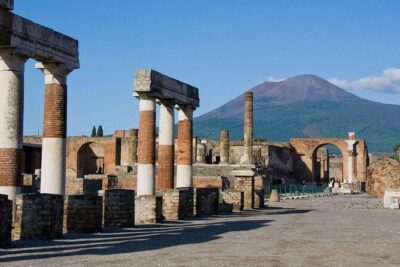
- Forum of Pompeii (Quick Central Stop)
- Capitolium and the Jupiter Statues
- Macellum and Via dell’Abbondanza: Market and Main Street Energy
- Stabian Baths: Roman Daily Life, Not Just Politics
- Lupanar: A More Provocative Stop
- Casa del Fauno: Wealth, Taste, and the Alexander Mosaic
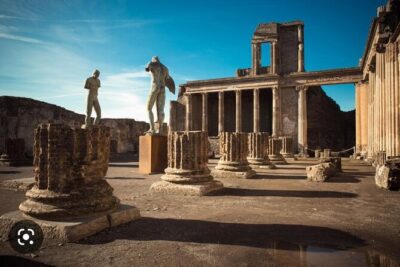
- Teatro Grande, Basilica, and the Forum Buildings
- A Realistic Heads-Up: Pompeii Is Hot and Exposed
- Vesuvius National Park: Climb, Views, and Volcano Perspective
- Crater Edge Stop (~1,280 m, about 30 minutes)
- Then Drop to ~1,000 m for More Time (about 1 hour)
- What Makes the Volcano Part Worth It
- How Transportation Shapes the Day (Positano Matters)
- Timing, Pace, and What to Expect Day-of
- Lunch and Food: Plan on It Being On Your Own
- What Kind of Traveler Should Book This?
- Should You Book This Pompeii and Vesuvius Day Trip?
- FAQ
- What is included in the tour price?
- How long is the tour?
- Is pickup available from my hotel in Positano?
- Is admission to Pompeii included?
- What happens if Mount Vesuvius is closed due to bad weather?
- Is lunch included?
Key Highlights You’ll Notice Right Away
- Private round-trip vehicle from Positano with an English-speaking driver, plus hotel/close-meeting-point pickup when reachable
- Priority access to Pompeii and Vesuvius so you spend less time waiting
- A licensed guide leading you through the Pompeii highlights, not just dropping you at the entrance
- Two Vesuvius stops: crater-edge views around 1,280 m and more time at about 1,000 m
- Real admission value included: Pompeii entry, Vesuvius National Park access, and the Vesuvius entrance ticket
Price and Logistics: What You’re Paying For
At $750.91 per person for a private day, this isn’t a bargain. It’s a “buy the day back” purchase: you pay for private transportation from Positano, a guide at Pompeii, priority entry at both sites, and admission coverage that would otherwise mean separate tickets and more time planning.
Here’s the practical angle. If you’re traveling as a small group, private makes more sense because the driver + guide time isn’t split across strangers. If you’re solo or two people, it can still be worth it when you value (1) less waiting and (2) a guided Pompeii that hits the best-known areas in the time you have.
One logistics note: pickup depends on vehicle access. If your hotel is reachable by car, you’ll meet your driver there. If not, you’ll go to the closest meeting point (near Parking Garage Mandara, Viale Pasitea 82). That’s important in Positano, where narrow roads and traffic rules can make “just show up at the entrance” harder than it sounds.
If you're still narrowing it down, here are other tours in Positano we've reviewed.

From Positano to Pompeii: The Easy Start
The day begins with door-to-door pickup from your Positano hotel when the vehicle can reach you. You then head straight to Pompeii. The big win here is not having to figure out timing, parking, buses, or where to stand to catch the right connection.
Once you’re at Pompeii, your priority access is meant to reduce the time spent lining up. At big attractions, those minutes add up fast—especially when your schedule includes both Pompeii and Vesuvius.
You should also know the tour is approximately 8 hours, and timing can shift with traffic and weather. That flexibility matters because Campania can be unpredictable, and Vesuvius depends on conditions.
Pompeii Highlights: A Guided Hit List That Still Feels Human
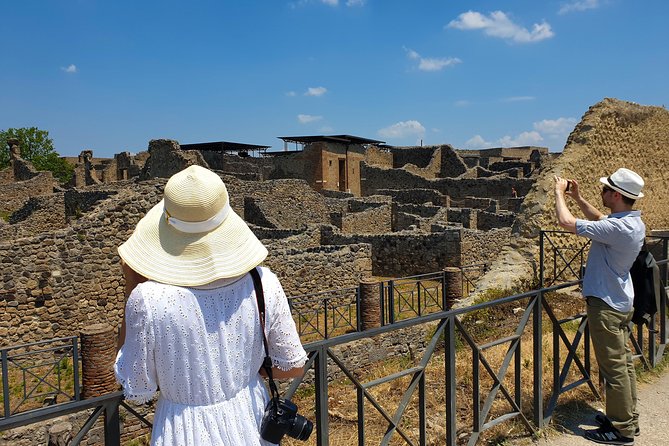
Pompeii is a whole city in ruins, not a single monument. With only about 2 hours at the site, the guide approach matters: you want someone who can steer you past the “nice-to-see” parts and into the streets and buildings that explain what life was like.
Archaeological Park of Pompeii (Main Stop, ~2 Hours)
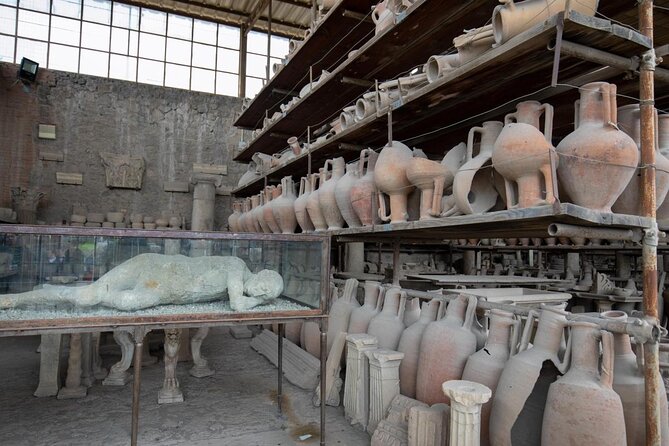
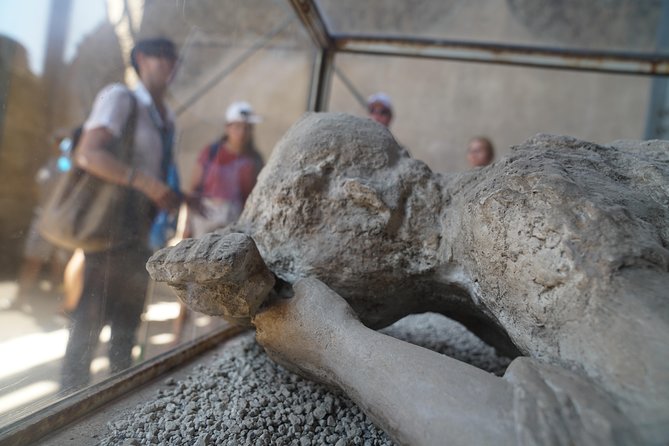
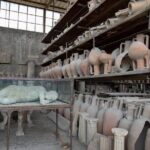
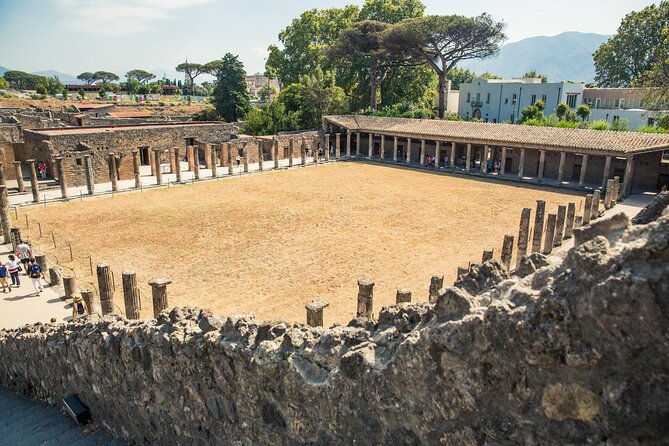
You’ll walk inside the Archaeological Park of Pompeii with your guide. Pompeii was a thriving Roman city that was buried under meters of ash and pumice after the catastrophic eruption of Mount Vesuvius in 79 A.D. Because of that cover, so much survives: street grids, building layouts, and everyday details.
In practical terms, this stop is where your guide gives you a frame: how Romans lived, how neighborhoods worked, and what you’re looking at when you see doorways, courtyards, and storefronts.
What I like about a guided “highlights first” plan is that you don’t spend your limited time wandering with no context. You get meaning as you walk.
Forum of Pompeii (Quick Central Stop)
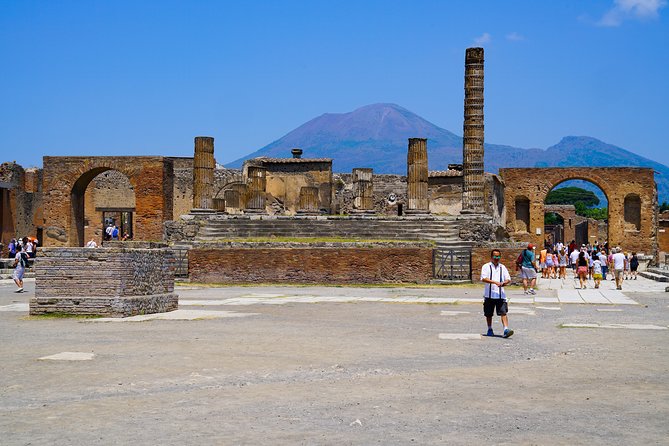
You’ll also make a stop at the Forum, Pompeii’s political and commercial heart. It’s described as a market and trade center with connections to politics, which is exactly what makes it useful. Even a short visit teaches you how the city organized power and daily commerce.
There’s only about 10 minutes here, so think of it as an orientation stop: where the city’s pulse was, and how the architecture supported public life.


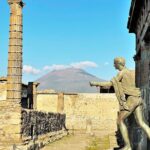

Capitolium and the Jupiter Statues
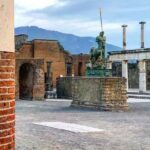
Next up is the Tempio di Giove Capitolino (Capitolium), tied to statues of Jupiter, Juno, and Minerva. Even if you only glance up at the framing of the space, the placement is the point: the statues were meant to be visible to people moving through the Forum area.
Macellum and Via dell’Abbondanza: Market and Main Street Energy
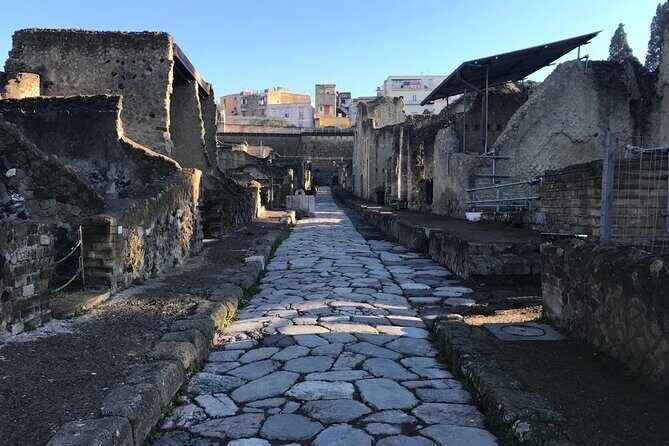
You’ll pass the Macellum, a provision market connected to the Forum, plus Via dell’Abbondanza, Pompeii’s main street (called the decumanus maximus). This is where Pompeii stops feeling like “ruins” and starts feeling like a real city with noise, shops, and foot traffic.
Via dell’Abbondanza is especially helpful for first-timers because it’s a recognizable artery: east/west through the city, linking major gateways and key zones.
Stabian Baths: Roman Daily Life, Not Just Politics
Then you’ll see the Stabian Baths (Terme Stabiane). These baths date to shortly after the colony of veterans, and you’ll get the layout idea: separate entrances for women and men, and zones for cold/tepid/hot bathing.
This stop is about how people spent time. It’s a great contrast to temples and civic buildings—especially in a day where you’re trying to understand the whole society, not just the dramatic parts.
Lupanar: A More Provocative Stop
You’ll also visit the Lupanar of Pompeii, the famous brothel area. It’s known for erotic wall paintings, and it’s historically significant as a window into social behavior and how the city functioned.
If that subject matter doesn’t interest you, you can still use it as a prompt to think about what Romans talked about in public spaces—and how private life existed next door to commerce and politics.
Casa del Fauno: Wealth, Taste, and the Alexander Mosaic
For many people, Casa del Fauno is the “wow” moment. It’s one of the largest and most luxurious residences in Pompeii, named for a bronze faun statue in the atrium. The house is especially famous for the Alexander Mosaic, showing the battle between Alexander the Great and Darius III.
Even with a short stop, the key value is the message: Pompeii wasn’t only about everyday workers. There was extreme wealth, luxury architecture, and high-end art.
Teatro Grande, Basilica, and the Forum Buildings
Finally, you’ll move through additional major public spaces, including Teatro Grande and the Basilica—both tied to civic life. The theater shows Greco-Roman dramatic traditions, while the Basilica functioned as a centerpiece for business and justice.
These stops help you see how public architecture shaped daily routines.
A Realistic Heads-Up: Pompeii Is Hot and Exposed
Pompeii can be brutal in warm months. There’s little shade in many areas, so you’ll want sun protection and water. Also, expect walking over uneven ground. A “highlights” tour is still a tour of a huge archaeological site.
Vesuvius National Park: Climb, Views, and Volcano Perspective
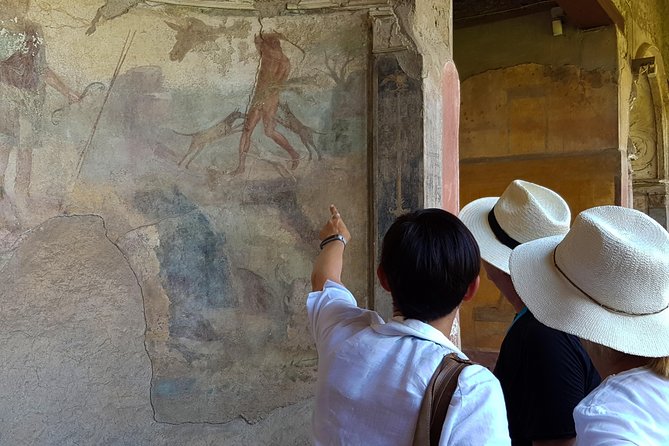
After Pompeii, you’ll head to Vesuvius National Park, and the schedule shifts from walking ruins to walking a volcanic route.
Crater Edge Stop (~1,280 m, about 30 minutes)
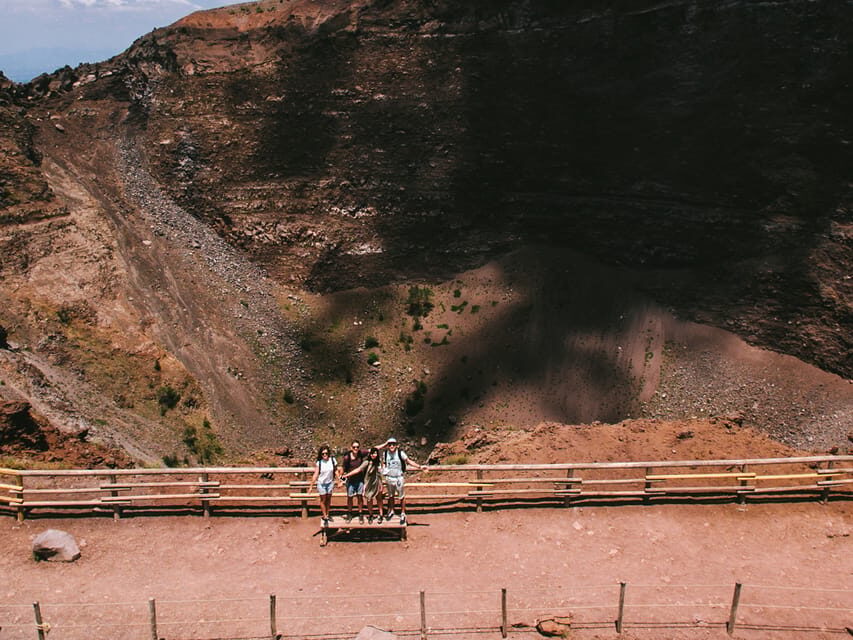
You’ll reach the crater area at around 1,280 meters. You’ll walk on a path with an uneven surface, and the goal is the panoramic view over the Gulf of Naples.
The crater itself is the big draw, but what makes this stop meaningful is the perspective. Once you see what’s below and around the volcano, Pompeii’s story stops being abstract. You can connect the eruption’s scale to the city’s location near the bay.
Then Drop to ~1,000 m for More Time (about 1 hour)
Next you’ll be dropped at roughly 1,000 m, with about one hour here. That gives you room to wander, take photos, and manage your pace.
One practical note: the air can feel chilly at elevation even when it’s warm in the lowlands. Bring a light jacket.
What Makes the Volcano Part Worth It
This isn’t a “stand and look” activity. It’s a short hike to a summit viewpoint that makes you work a little—but you get a payoff: a first-hand sense of why this place is considered dangerous and why monitoring matters.
And yes, some of the Vesuvius path can feel steep. If you’re not used to hills or rough terrain, plan for slow steps and frequent breath-catching pauses.
How Transportation Shapes the Day (Positano Matters)
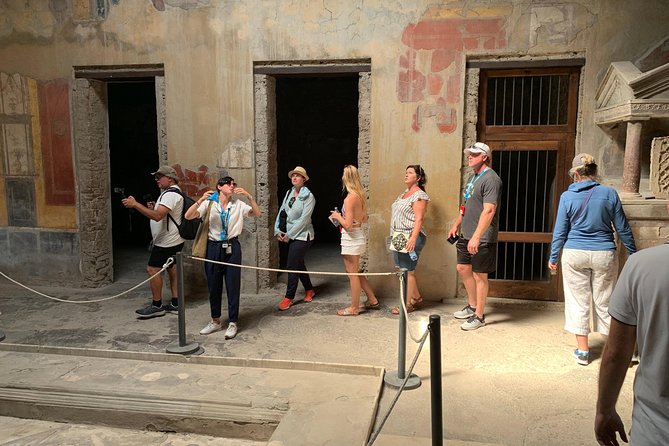
A big reason this tour gets attention is the private vehicle. Positano is gorgeous, but moving around can eat time. A driver keeps your schedule tight and reduces the chance you’ll lose the day to transit confusion.
Also, you’re not alone in the driving part. You’ll have an English-speaking driver doing the navigation, and your guide handles the historical walk at Pompeii.
This is also why the tour can be enjoyable even when you’re tired: you’re not planning “how do we get there next?” every couple of hours.
Timing, Pace, and What to Expect Day-of
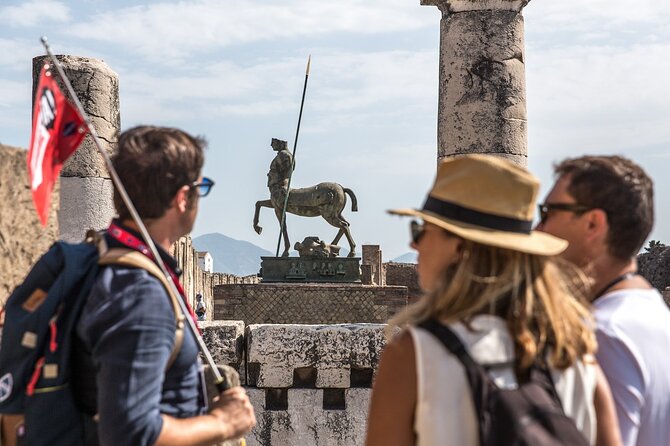
The itinerary is designed like this: concentrated Pompeii highlights, then a volcano climb. That means your Pompeii walk is shorter than what people might want for a full self-guided day.
So here’s how to think about it:
- If you want to see most important sights with context, this tour works well.
- If you want to read every inscription and explore every corner slowly, you’ll want a longer Pompeii visit on another day.
Bring comfortable shoes. Even if you’re not a hardcore hiker, the Vesuvius section asks for sure footing. Pompeii’s ground can be uneven too.
Lunch and Food: Plan on It Being On Your Own
Lunch is not included. The tour schedule still gives you a break between Pompeii and Vesuvius, but you’ll be choosing your own meal.
I suggest treating lunch like part of your pacing. Pick somewhere that works for you (quick and easy, or sit-down and slower), and don’t assume the first option will feel great after a hot Pompeii walk.
If you’re picky about quality or seating, it helps to have a plan before you’re hungry—water first, then food.
What Kind of Traveler Should Book This?
This is a good fit if you:
- want a one-day Pompeii + Vesuvius plan from Positano
- value priority access and minimizing waiting
- prefer a licensed guide to steer you through the key Pompeii zones
- are comfortable with a moderate amount of walking and uneven terrain
It’s less ideal if you:
- want a long, unhurried Pompeii day with lots of wandering
- don’t feel steady on hikes or rough paths
- dislike tours with a set route and time limits
If you’re traveling during warm weather or you’re visiting with kids, talk to the team ahead of time about pacing. The tour is designed for most people, but Vesuvius is where the physical demand shows up.
Should You Book This Pompeii and Vesuvius Day Trip?
I’d book it if you want the best of both worlds—Pompeii’s city-scale ruins plus the crater views—without the hassle of managing transport and tickets. The priority access and private pickup are the real value drivers, not just the headline destinations.
I’d think twice if you’re the type who needs hours and hours per stop, or if uneven hiking terrain is a hard no for you. In that case, consider a slower Pompeii-only day and another time for Vesuvius.
Overall, this tour is a strong “day trip with real substance” from Positano: structured, guided, and built to keep your time focused on the places that make the story click.
FAQ
What is included in the tour price?
Priority access to Pompeii and Mount Vesuvius National Park, a Vesuvius entrance ticket, a licensed private guide for Pompeii, and private round-trip transportation with an English-speaking driver are included.
How long is the tour?
The tour is listed as about 8 hours.
Is pickup available from my hotel in Positano?
Yes. If your accommodation is reachable by vehicle, you can meet the driver directly there. Otherwise, pickup is at the closest meeting point.
Is admission to Pompeii included?
Yes. Pompeii admission is included, with priority access to the archaeological site.
What happens if Mount Vesuvius is closed due to bad weather?
If Vesuvius is closed because of bad weather, you’ll receive a refund of the entrance fees for the volcano.
Is lunch included?
No. Lunch is not included. You’ll have a break during the day for your own meal choices.